
4 big truths about community (and AI) from my chat with Gina Bianchini
I just dropped a new video/podcast with Gina Bianchini, founder and CEO of Mighty Networks. I made this to help creators and community builders focus on what actually drives connection and growth.
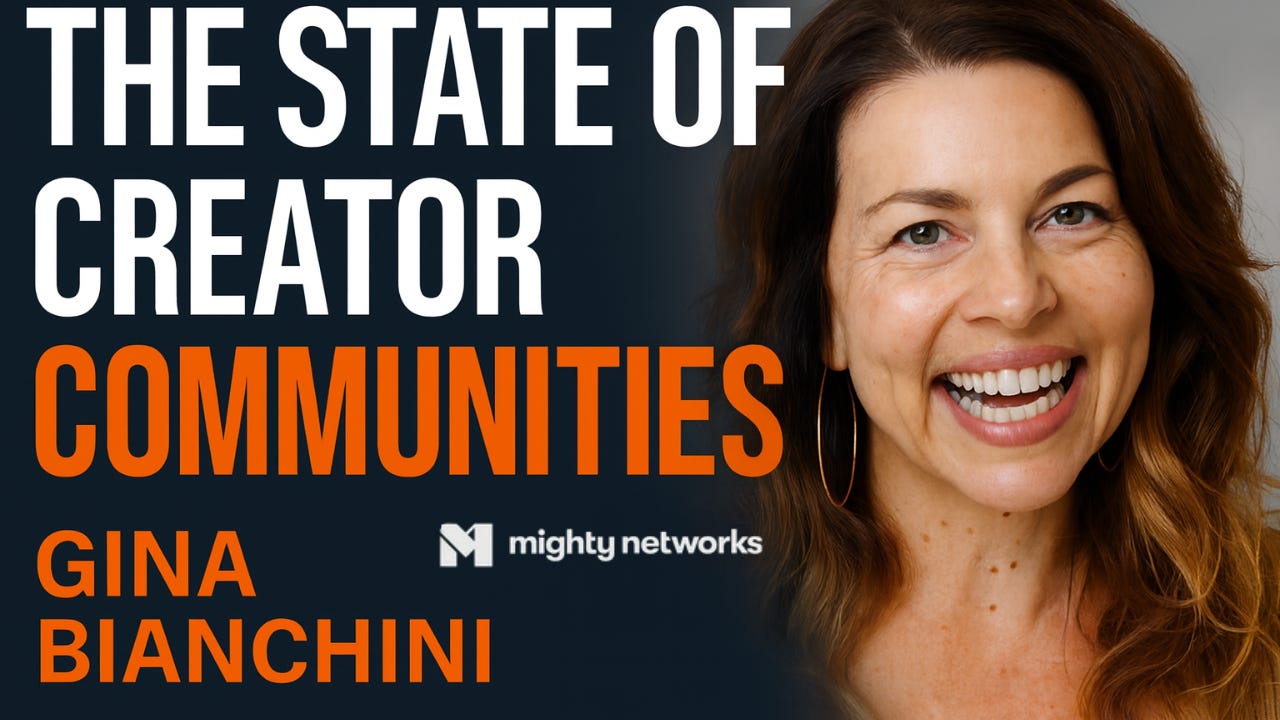
You’ll learn what “People Magic” looks like in practice and how to balance AI with real human relationships.
Before we dive in
This episode is for creators, coaches, founders, and community leaders who want stronger engagement and better retention. It matters because attention is crowded—and real connection is your edge.
1) Community ≠ Audience
Most of us blur these two. Gina drew a clear line. A community is people building relationships with each other. An audience is just you and them.
She said it plainly: “A set of people who have relationships with each other versus an audience which only has the relationship with the creator.” That single shift changes how you design offers, price, and measure success.
My take: Stop selling “access to me.” Start hosting the room where members meet the most important people in their lives.
2) People Magic beats “synthetic people”
We talked about the flood of AI avatars and digital twins. Gina warned that if we don’t use tech to bring humans closer, we risk losing the social fabric.
Her words stuck with me: “If we do not create communities of real human beings enabled by the very best technology… we are at real risk of losing social fabric.” AI is great. But let’s use it to match, introduce, and remove social risk—not replace people.
My take: Use AI to create momentum (pairing members, surfacing wins), not as a stand-in for the host.
3) Make the community the product
Creators often assume members pay for content or access to the host. But the data on Mighty Networks shows something else: members stay and pay for relationships and shared progress.
Gina put it this way: “If you make it about you, you will underprice relative to what people will pay when it’s all about the community.” When members meet others on the same path, they come back for each other. That’s durable.
My take: Price and package around outcomes and experiences (small groups, challenges, meetups), not just videos and posts. This one was a huge a-ha moment for me!
4) Design for groups and real-life moments
Modern chat moves fast. Swipes, scrolls, DMs—it’s noisy. Gina’s team builds for “groups and clusters,” not one-off transactions. Why? Because showing up at the same place and time is still hard—and still where trust forms.
She joked about trying to plan with friends over text and one person blowing up the thread with “that date doesn’t work.” We’ve all been there. Tools should make it easy to meet, match, and gather—online and offline.
My take: Add structure: recurring circles, office hours, coworking, and light-weight events. Make it easy to raise a hand and find “your people.”
Bonus: Charge for experiences, not attention
One of Gina’s favorite lines came up again: “People pay attention to what they pay for.” But they’re not paying for your inbox. They’re paying for you to remove social risk, help them through a transition, and feel welcome on day one.
My take: Your onboarding is the product. Give every new member a path, a buddy, and a first win within 7 days.
Key points to remember:
Community is members-to-members; audience is you-to-them.
Use AI to spark human connection, not replace it.
Price around outcomes and relationships; content alone won’t cut churn.
Structure beats chaos: small groups, regular sessions, clear paths.
“People pay attention to what they pay for.”
There’s more where that came from
In the full episode, Gina shares:
Why 84% of activity on Mighty is driven by members (and what that means for your roadmap).
The bold thing her team is building next—and why it’s “hard AF,” but worth it.
Ready to dive deeper?
The full conversation runs about 36 minutes and goes deeper into designing community as your core product. Watch it here: [link]
I think you’ll leave with a simple filter for every decision: does this help members meet the most interesting people on the same path?
Thanks for reading—and for caring about people first.
—James
🥃
P.S. What’s one small change you could make this week to help two members meet each other? Reply and tell me; I’ll send back a quick idea to make it happen.


