



You can spend so much time choosing the right platform, polishing the right message, and planning the perfect comeback that you never actually put your work into the world.
Meanwhile, the subscription charges keep hitting. The ideas keep piling up. And the thing you are genuinely good at stays on the sidelines.
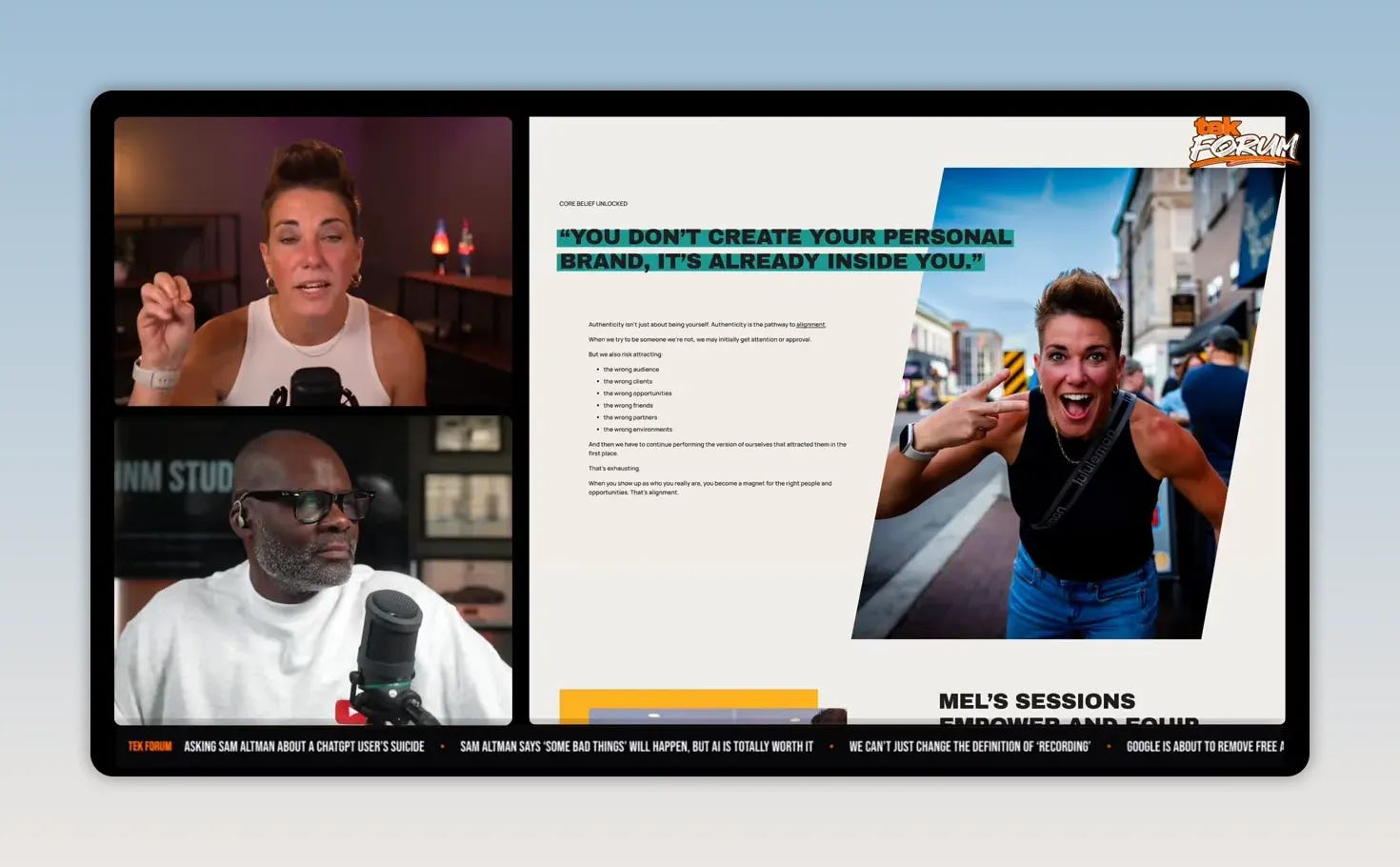
That is what makes Mel Dyann Howe’s return to content creation, coaching, and speaking worth talking about. Yes, there is a website rebuild involved. Yes, Claude and ChatGPT helped. But the real story is about getting back into alignment, moving past perfectionism, and using technology to make more room for the work that requires you.
The goal is not to let AI become you. The goal is to stop letting everything else get in the way of being you.
Getting Back Into Alignment, Not Just Back Online
Mel had been active in live streaming, podcasting, and helping people get comfortable with live video. She contributed to StreamYard’s content, ran a live video boot camp, and had experience running a marketing agency.
Then a corporate opportunity came along. It was something she wanted to try, and she figured she could keep her own content and programs going on the side.
You know how that goes.
A couple of weeks without a live session became a longer gap. Occasional experiments and comeback announcements did not turn into a sustained return. Before she knew it, roughly four years had passed.
She described it like getting away from the gym. Two weeks off becomes four weeks. Then somehow it is four months, and coming back feels harder than it did when you first stopped.
When her corporate job ended, the question was not simply whether to take another corporate role. It was whether the next step would fit the things she had been missing:
Creating content in her own voice.
Speaking and bringing energy into a room.
Working with groups through coaching and workshops.
Helping people believe in the value of putting themselves out there.
Alignment became the word that kept coming up. Not a carefully selected slogan for the year, but a practical way to evaluate what came next.
That matters. A new website can support a new direction, but it cannot choose that direction for you.
You Can Be Scrappy Without Being Sloppy
There is something encouraging about the current creator environment: you do not need a massive production operation to make useful things.
Creators are building tools, experimenting with platforms, and getting ideas into circulation without waiting for every detail to look like a polished corporate launch. Mel had been experimenting too, moving among WordPress, Kajabi, and Carrd as she considered what she needed.
But experimentation has a trap. At some point, tinkering stops moving the project forward.
Scrappy is a way to get the work done. It should not become another way to avoid finishing.
What felt different for Mel this time was the availability of tools that could help her work lean without producing something careless. She could build a credible home for her personal brand without recreating every piece of her old business infrastructure.
I also keep coming back to owning your digital real estate. Having a domain associated with your own name gives your work a clear home. Platforms can be useful, but there is value in having a place where people can find your message, understand your work, and contact you directly.
The Nearly $8,000 Lesson: Buy for the Business You Have
Mel’s original website was a simple WordPress site. When she started offering courses and paid programming, Kajabi made sense.
It brought several functions together. She moved her email marketing from Mailchimp, built courses, sold products, and managed the website in one place. When that business was generating revenue, the expense had a purpose.
The problem came when her own programming stopped generating revenue but the platform stayed.
She kept thinking she would return to courses. She would start selling again. She would make use of the features again.
In the meantime, she was paying around $179 a month at one point, and the cost of leaving felt bigger than the cost of staying. Those are figures from her experience, not a statement of current pricing.
A migration meant dealing with far more than a homepage:
A substantial collection of blog articles.
Email contacts and a future email marketing strategy.
Free courses and other lead magnets.
Course videos, PDFs, and supporting documents.
Decisions about which old content belonged in the next version of the business.
That is a lot to sort through when you are still figuring out what you want to do next.
Mel eventually calculated that she had spent almost $8,000 over those years on a platform she was not meaningfully using. Her comparison was painfully good: she had rented a mansion and spent her time in one tiny bathroom.
This is not an argument that Kajabi is a bad platform. She was clear that it can be an excellent all-in-one resource. It was simply too much platform for her needs at that stage.
A tool can be excellent and still be wrong for your current business. Paying for a future version of yourself does not automatically help that version arrive.
Start With a Conversation, Not “Build Me a Website”
Mel first used ChatGPT to think through her next direction. She shared existing material, discussed previous speaking sessions and programming, and explored possible frameworks.
The experience was energizing. It felt less like staring at a blank page and more like having an advisory group available to help her sort through ideas.
But encouragement did not erase the migration problem. She stepped away, returned, reconsidered platforms, and eventually began doing more structured work in Claude.
She had not suddenly become an expert in every AI feature. In fact, the speed of change had made it easy to feel behind. The further away she got from the tools, the harder it felt to catch up.
What helped was using them on smaller, real projects. She asked for assistance with descriptions and titles for short-form content. She worked on workshop frameworks. Those conversations gave the website project more useful context about her beliefs, language, and direction.
Then she made an important change: she explained not only the project, but how she needed help working on it.
Give the AI a Useful Role
For this project, Mel asked Claude to act as an integrator. She did not need endless enthusiasm or a wall of text. She needed something that could help translate ideas into action and keep her from overcomplicating the next step.
She told it she was an overthinker, a procrastinator, and a perfectionist. She asked it to challenge her when those habits started taking over.
That is a much more useful instruction than asking for a website and hoping the tool figures out everything else.
You do not need to make prompting mystical. Be specific about what you want, what you do not want, and where you are stuck.
Explain who you are: your work, audience, voice, and future direction.
Define the role: brainstorming partner, copy assistant, technical guide, or execution support.
Set the pace: one manageable step at a time rather than a complete plan all at once.
Describe your friction: too many options, overly long answers, fluffy language, or premature building.
Invite clarification: ask for questions where information is genuinely missing.
Tell It When You Are Still Thinking
One of Mel’s frustrations was that the AI would start building before she was ready. She wanted to brainstorm, and suddenly it was producing a mockup.
Asking for questions helped, but a long interview with multiple-choice answers could become another obstacle. So she became clearer about the kind of conversation she wanted.
She would explain that she was thinking out loud, that an idea might change halfway through, and that she wanted clarification only where it was needed.
That allowed the work to become more iterative. Step one and step two could change what step three should be. There was no need to decide step five before doing anything.
You are allowed to need baby steps. Tell the tool that.
How AI Helped Remove the Migration Roadblock
When Mel returned to the website project, she finally gave it a concrete priority: get off the expensive platform, start simple, and add more later.
She was willing to give Squarespace another try, even though earlier experiences with it had frustrated her. But first, she needed to preserve the old material.
Claude suggested using Cowork for the export work. That made her nervous. Letting an AI tool explain something is one thing. Letting it work with files and interact with a platform is another.
Rather than pretending she was comfortable, she said she wanted to proceed carefully. The chat then guided her through the setup and the instructions for the task.
Create a destination folder. Establish where the exported material should go.
Set up the Cowork task. Explain the work and direct it to the relevant location.
Install the browser extension used in her process. Follow the prompts with guidance from the chat.
Troubleshoot the download issue. She shared a screenshot of an error, and the guidance helped her redirect the download folder.
Export and organize the old content. Preserve the material in folders, including usable copy and visual references.
In her case, the process took about an hour from the initial plan to an organized export. She ended up with Google Docs containing page copy, PDF references showing what pages looked like, and archived course materials, including videos and PDFs.
The significance was bigger than the time saved.
She might never use much of that material again. But knowing it was preserved gave her enough confidence to move forward. She no longer had to keep paying for the old platform simply because she was afraid of losing something.
Sometimes the most valuable automation is the one that removes the fear keeping you stuck.
AI Assisted the Website. It Did Not Build Everything for Her.
This distinction needs to be clear: Cowork handled the export and some backend work in Kajabi. It did not code the new website.
Mel used the Claude chat to develop and organize website content. She built the site in Squarespace, chose the images herself, and made the final decisions.
Claude suggested the kinds of images that might fit particular sections, such as a strong smiling portrait for the hero area or a speaking photo elsewhere. That is guidance, not the same thing as choosing every asset and building the site.
Use the First Draft as a Starting Point
Mel does not consider herself a copywriter, graphic designer, or IT specialist. Her strengths are strategy, vision, and ideas. Starting from nothing can take her a long time.
AI gave her something to respond to.
She edited heavily, pushed back on language that felt fluffy or off-brand, and went through multiple rounds when necessary. On a separate client project, getting one title right took about six iterations.
That is not a failure of the process. That is the process.
Working with an AI copy assistant can resemble working across the table from a copywriter: explain what is wrong, provide direction, compare options, and keep refining until the language feels right.
Ask for a Visual When Words Are Not Enough
The website copy hierarchy was making sense. The visual layout was not.
Squarespace offered page sections and starting blocks, but Mel struggled to connect the written structure to the choices inside the builder. She needed to see it.
Once she said that clearly, Claude produced a mockup or wireframe in the chat. Suddenly the structure became understandable:
Image on one side, text on the other.
A large heading followed by a short supporting sentence.
Three blocks arranged together.
A longer banner image breaking up the page.
Then she could choose the corresponding blocks and build. She sent screenshots of her progress back to Claude, asked it to review what she had done, and had it update the mockup to reflect her changes.
Brand colors evolved through that same back-and-forth. Too much yellow? Too much teal? Too many colors competing in one section? She could point to the actual problem rather than trying to describe everything abstractly.
Even small workflow details helped. Mel programmed her hex color values into her Stream Deck so they would be easy to reuse.
When I reviewed the site, I looked beyond whether it looked good. I checked spelling, links, and whether the personal story came through. A polished page still needs the practical checks.
Your Origin Story Is Not Something AI Can Invent for You
One of the strongest parts of Mel’s website was a story about a teacher asking for two boys to carry classroom books.
To understand why that moment matters, you need the context.
As a child, Mel loved sports, being outside, and playing with Ninja Turtles and G.I. Joe toys. Her great-grandmother understood what she liked and bought those toys for her, even when other relatives wanted to steer her toward something different.
She enjoyed her friendships with girls, but she often preferred the activities the boys were doing. She was competitive, athletic, and good at those activities. She also got teased.
So when a teacher needed strong boys to carry boxes of books, she heard an assumption that excluded her before she had a chance to participate. She knew she could carry them. She wanted the opportunity to prove it.
That experience stayed with her. It helps explain both her competitiveness and why she cares so deeply about people recognizing and using their capabilities.
AI did not supply that meaning. Mel did.
She shared why the work mattered, where she struggled, and what experiences had shaped her. That gave the tool something real to help organize into website copy and speaking material.
Authenticity Requires More Than a List of Accomplishments
A generic request for a personal branding website will produce generic personal branding language. How could it do anything else?
The useful material includes more than credentials:
Values: what matters enough to guide your decisions.
Standards: what you will and will not do.
Role: how you help people and why that work belongs to you.
Style: how you speak, move, dress, and connect.
Origin: the experiences that help explain your mission.
Friction: fears, failures, and habits that affect how you work.
For Mel, stage presence means comfortable clothing, movement, and energy. A polished image that puts her in a style she would never wear does not become authentic just because the copy sounds professional.
The same applies to her childhood school photo. She once found it embarrassing, especially after a friend laughed when she showed it to him. Years later, she could share it with humor and ownership.
That photo became part of the same story: the girl who wanted a chance to carry the books, now willing to show up as herself.
Using AI to help express your story is different from asking AI to manufacture your identity. You should be able to explain the direction you supplied and stand behind the final result.
Be Open About Your Story, Careful About Your Data
Being vulnerable with a tool does not mean giving it everything.
Mel had been more cautious with AI than she typically was with new technology. Early interfaces felt difficult to understand, and hearing about tools deleting emails or manipulating files made her hesitate.
Her own boundary was practical: the personal stories she shared were largely things she would also be willing to discuss onstage. She was not treating the tool as a place for highly confidential discoveries or proprietary material.
Her bigger concern was allowing it to take action.
That distinction is useful. Sharing context for copywriting and granting access to files are different decisions. Walk before you run. Understand what a tool can touch, keep the scope clear, and stay involved in consequential actions.
For guidance on a specific AI product, use its official documentation, such as the Claude Help Center, rather than assuming the assistant always knows its own current features.
Plain-language explanations of data handling matter too. Our privacy policy is one example of the clarity people should expect about collection, use, and removal of their information.
Keep Humans in the Process
I am excited about what these tools make possible. I also do not want the human element disappearing while companies race to release the next model.
Competition can bring useful improvements, but speed and commercial incentives also raise legitimate questions about oversight. Who is checking what the tools do? Who is responsible when they act beyond the intended scope? Where does human judgment remain?
There is no need to pretend we know exactly what AI will look like in six months, much less six years. But we can insist that responsible use includes attention, accountability, and human review. The NIST AI Risk Management Framework offers supporting context for that broader conversation.
A paid subscription may give you access to features or models that fit your work better. It does not remove your responsibility to verify the output. For Mel, paying also encouraged a more structured commitment to using the tool.
Use the Time You Save for Work That Requires You
While Cowork handled the export, Mel recorded LinkedIn videos on her phone.
That is the part I want people to catch.
She did not merely save an hour of keyboard work. She redirected that time toward showing up in her own voice.
Her position on an AI version of herself was clear: she did not want a digital twin replacing her coaching or her personal presence. That is her boundary, not a rule everyone else has to adopt.
Still, knowing how AI twins work could be useful for her consulting. If a marketing team or business leader asks about one, she needs enough understanding to discuss the benefits, drawbacks, and fit.
Understanding a technology does not obligate you to use it in your own brand.
Something can be popular and still be wrong for your business. Learning enough to make an informed decision is different from chasing a trend because somebody else is getting attention with it.
Will AI Replace People? Start by Looking at Tasks.
The concern is real. Technology can replace tasks, and it can change or eliminate some task-oriented roles. Administrative, repetitive, tactical work is part of that conversation.
Mel compared it to a robotic arm making French fries. The machine may handle the action, but somebody still has to care whether the food meets the standard.
That is the practical distinction: performing an operation is not the same thing as carrying all the judgment, responsibility, and relationship around it.
We also discussed potential uses in dangerous work, such as robots or drones entering situations where people would otherwise face significant risk. There are worthwhile opportunities there, without treating every form of automation as automatically safe or appropriate.
For creators and entrepreneurs, the useful starting question is more immediate:
Which routine tasks keep pulling you away from the work people need you to do?
Mel believes that as generated content becomes more common, people will increasingly value real proximity, handmade work, and human connection. That is an opportunity to lean into your strengths, not a guarantee that every creative business will be unaffected.
Artists: This Is a Reason to Become More Visible
There is a lot of generic AI content out there. We are losing patience with it.
That does not mean skilled designers, photographers, videographers, muralists, and craftspeople should disappear. Mel sees the opposite opportunity: make the difference between generic output and your particular talent easier to recognize.
We talked about graphic designer Marshall Fox, whose confidence comes from his own design judgment, client conversations, and creative process. His approach is not simply to ignore AI. It is to consider how he can use it without surrendering the value of his own hand in the work.
Mel drew a parallel with the fear that better iPhone cameras would eliminate demand for high-end photography. Her point was that easier access to basic output can make distinctive expertise more important to communicate.
But communicate is the key word.
If you have been hidden behind an agency or behind your computer, clients may not know why they should choose you. Agencies may also see automation as a way to increase margins, which makes relying only on that channel a risk.
Put your face on your website.
Explain why you make the creative choices you make.
Share the process, not just the finished piece.
Let people understand your preferences, standards, and perspective.
Build relationships around the person doing the work.
People remember artists. They hang the work on their walls and talk about the person who made it. Give them a chance to know that person.
Automate the Administration, Not the Art
Mel is working with her muralist friend Ashley Runkle on reducing the work that takes time away from painting. Drafting quotes and handling supporting business tasks are places where AI assistance can help.
The mural itself still requires the artist.
Sharing the process adds another layer. A large mural that takes four weeks to complete carries a different meaning when people have seen it develop. They understand that a real person brought it to life.
The same principle applies to woodworking and other hands-on trades. Skill, personality, and a community of people exchanging knowledge all contribute to the value. The finished object is only part of the story.
Let AI reduce the work surrounding your craft so you can spend more time practicing the craft.
Separate Your Offers When Combining Them Dilutes the Message
Mel’s next direction has two related but distinct parts.
Her personal brand is focused on coaching, speaking, motivation, and helping people understand the power of putting themselves out there. That includes conferences, podcast conversations, group work, and workshops.
Her agency work focuses more directly on business consulting: marketing strategy, helping teams connect with clients, business growth, and bringing in partners for specialized execution.
Those partners could help with work such as app development or AI integration. If that kind of collaboration fits your business needs, you can book a strategy or partnership conversation to discuss the scope.
For Mel, keeping the two directions separate helps her personal message stay focused. Trying to make one website explain every possible service would water down the part she is most passionate about.
That does not make the agency work less meaningful. It gives each audience a clearer understanding of why they would hire her.
Ship the Small Version, Then Keep Going
The website Mel launched was only two pages.
It did not contain all her podcast media. It did not fully explain her workshops. It was not the final expression of everything she might eventually build.
It was enough to start.
That is the lesson running through the entire process. The big goal gets intimidating when you mentally stack every required task in front of it. Migration, copy, colors, photos, services, frameworks, content, speaking opportunities. No wonder you feel stuck.
But progress does not arrive as one enormous finished thing. It arrives through smaller actions that also help you get clearer.
Preserve the old material.
Choose a platform that fits now.
Build the essential pages.
Make the message sound like you.
Publish.
Add the next useful piece.
One post usually will not make your whole dream happen. That also means one imperfect post does not need to carry the weight of destroying it.
Make the post. Learn something. Make the next one.
You do not need a perfect comeback, a giant website, or mastery of every AI tool before you begin. You need enough clarity to take the next honest step, and enough willingness to take another after that.
Don’t let your gifts go ungiven. Give them somewhere to go.