




AI has lowered the barrier to building. That part is real. You can prompt your way into a website, prototype an app, automate a task, create a workflow, and put a branded experience in front of somebody faster than ever before.
But let’s be clear: being able to build something does not automatically mean you should build it.
The real opportunity is not to throw a bunch of AI-generated apps at the wall and hope one catches. The opportunity is to take the expertise you have earned, identify a genuine problem, and build a solution that is useful, secure, scalable, and worth putting your name on.
The Technology Is No Longer the Excuse
For years, having an idea was only the beginning of an expensive, complicated journey. You needed developers, designers, project managers, infrastructure, hosting, testing, support, and probably a few late-night conversations with somebody asking why the site was down.
That friction has changed dramatically.
Today, AI tools, no-code platforms, reusable components, APIs, and white-label services make it possible to create what once required a full development team. You do not have to be a solutions architect or a full-time coder to get started. You do need to learn how to communicate clearly with the tools, understand what you are trying to achieve, and make smart decisions along the way.
You can ask tools like Claude, OpenAI products, and Google AI products to help you develop ideas, structure a project, write code, create content, and improve a workflow. That access is powerful. It also comes with responsibility.
There is no longer a technology excuse. If there is something you have wanted to build, the path is more open than it has ever been. The question is whether you have a real plan behind it.
Build for a Real Problem, Not Because You Found a New Tool
The wrong starting question is, “What can AI do?”
The better question is, “What problem already exists that I understand well enough to solve?”
There is a whole lot of noise out here. Plenty of people are launching apps because they can generate one quickly. Plenty of people are spending credits, burning through tokens, making landing pages, and building software nobody actually needs.
That is not a business. That is a very expensive hobby.
Before building anything, get specific:
Who has the problem?
How often does it happen?
What does it cost them in time, money, attention, or opportunity?
What are they using today to work around it?
Would they actually trust your solution enough to use or pay for it?
Can you clearly explain why your approach is better?
If you cannot answer those questions, slow down. Do not start building in a vacuum.
Talk to the people who might use the thing. Ask them to explain their current process. Let them show you the annoying steps, the duplicative work, the things they always forget, and the workarounds they hate. That is where useful product ideas come from.
Expertise Is the Differentiator
AI can help many people generate a first draft. It cannot replace the context earned through years of doing the work, dealing with the failures, understanding the edge cases, and seeing what happens after the shiny demo is over.
In enterprise technology, that distinction matters. Building systems has never been only about putting buttons on a screen. It means considering security, authentication, data access, performance, business value, reliability, and the ability to scale.
The same standard should apply to an AI-powered business solution.
If your application collects somebody’s name, email address, phone number, physical address, or payment information, security is not optional. You need to think about authentication, access controls, row-level security, data handling, and the policies that protect the people trusting you with their information.
Anyone can release something quickly. But when a product is poorly built, insecure, impossible to support, or unable to grow, the consumer will figure that out. The quick money fades. The noise fades. Your name, however, remains attached to what you put out.
Do not put your signature on something subpar just because the tool made it easy to create.
Start With Intent and Purpose
The goal is not to build every possible product. The goal is to build the right components that support a larger outcome.
A good solution should help people reclaim time, reduce unnecessary steps, and move from tactical busywork into more strategic work. If a product does not create that kind of value, it needs a serious conversation before it gets built.
That means looking for opportunities to:
Eliminate repetitive steps in an existing workflow
Reduce the number of disconnected tools people must manage
Make a complicated process easier to operate
Help someone focus on their core work instead of administrative tasks
Create a better experience for a community or client base
Build a reusable framework that can support more than one person or organization
Think of it like building an airplane. You do not want to construct the entire thing while you are flying it. Build the wheel. Build the wing. Test the components. Understand how they connect. Then bring the full suite together with intention.
Example: Build the Workflow Around the Creator, Not the Platform
Creators and business owners often need to manage a pile of production tasks before, during, and after a live show. Scenes, overlays, lower thirds, calls to action, tickers, guest information, branded elements, merchandise links, and collaboration details all have to be handled while someone is trying to have an actual conversation.
That is a real workflow problem.
A solution like Q Hub was built from the practical need to manage multiple shows and production environments. The goal is not just to add another tool to the stack. The goal is to put the administrative and production elements in one place so the person on camera can focus on the content and the people in the room.
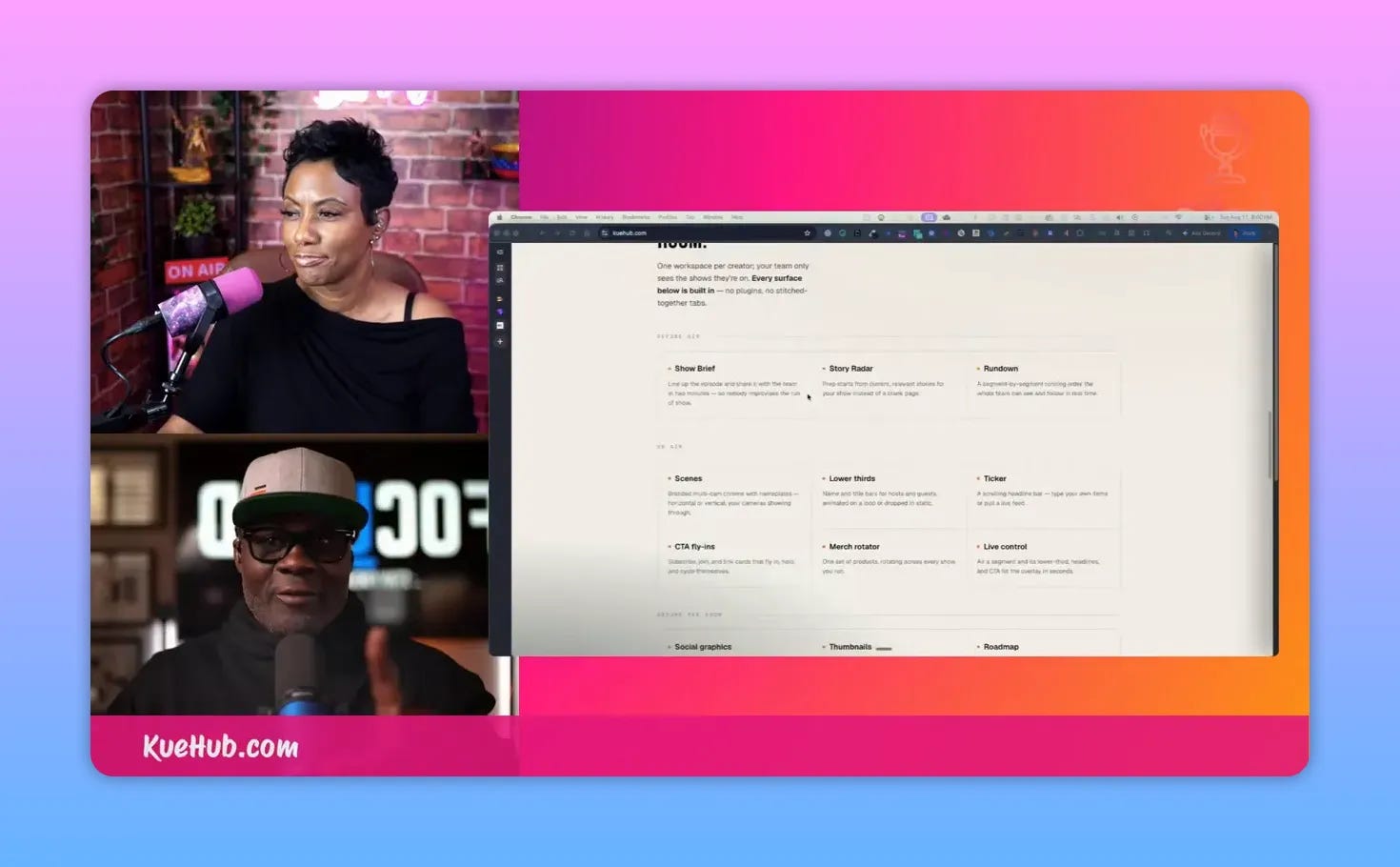
A useful production system can centralize:
Scenes and overlays
Lower thirds and on-screen calls to action
Scrolling tickers and timely information
Merchandise and store integrations
Collaborator access and shared production details
Fast edits that update immediately across the environment
That is the difference between building a random feature and building a solution. The feature is a lower-third editor. The solution is a workflow that lets the producer stay present in the conversation instead of worrying about whether somebody’s name is misspelled on screen.
Design for Scale From the Beginning
If you build something that helps you, there is a good chance it can help other people too. But that only becomes possible if you think beyond yourself from the beginning.
One of the most important concepts here is multi-tenancy. In plain language, that means building a system that can serve multiple people or organizations while keeping each environment separated, branded, and manageable.
That approach gives you options. A solution can potentially be:
Used internally for your own business
Offered to a community
Sold as a product
Delivered as a service
Used in an agency model
It also pushes you to think about the pieces that matter before launch: permissions, user roles, data separation, customization, support, maintenance, and integrations.
Build with the assumption that people will need to access their work from a desktop, laptop, tablet, or phone. Build with the assumption that people will use different production tools and different devices. Build for the actual world, not just the demo in your browser.
Move Beyond the Basic PDF Experience
Basic PDFs, static templates, and generic spreadsheets have their place. They can still be useful. But they are not the whole play anymore.
People increasingly expect more relevant, interactive, and responsive experiences. If someone is trying to move from a beginner conversation into a deeper level of learning or implementation, a plain download may not be enough.
That is where a more connected platform can make a difference. A solution like TechSync can combine information, community, direct feedback, asynchronous communication, workshops, and branded spaces into one environment.
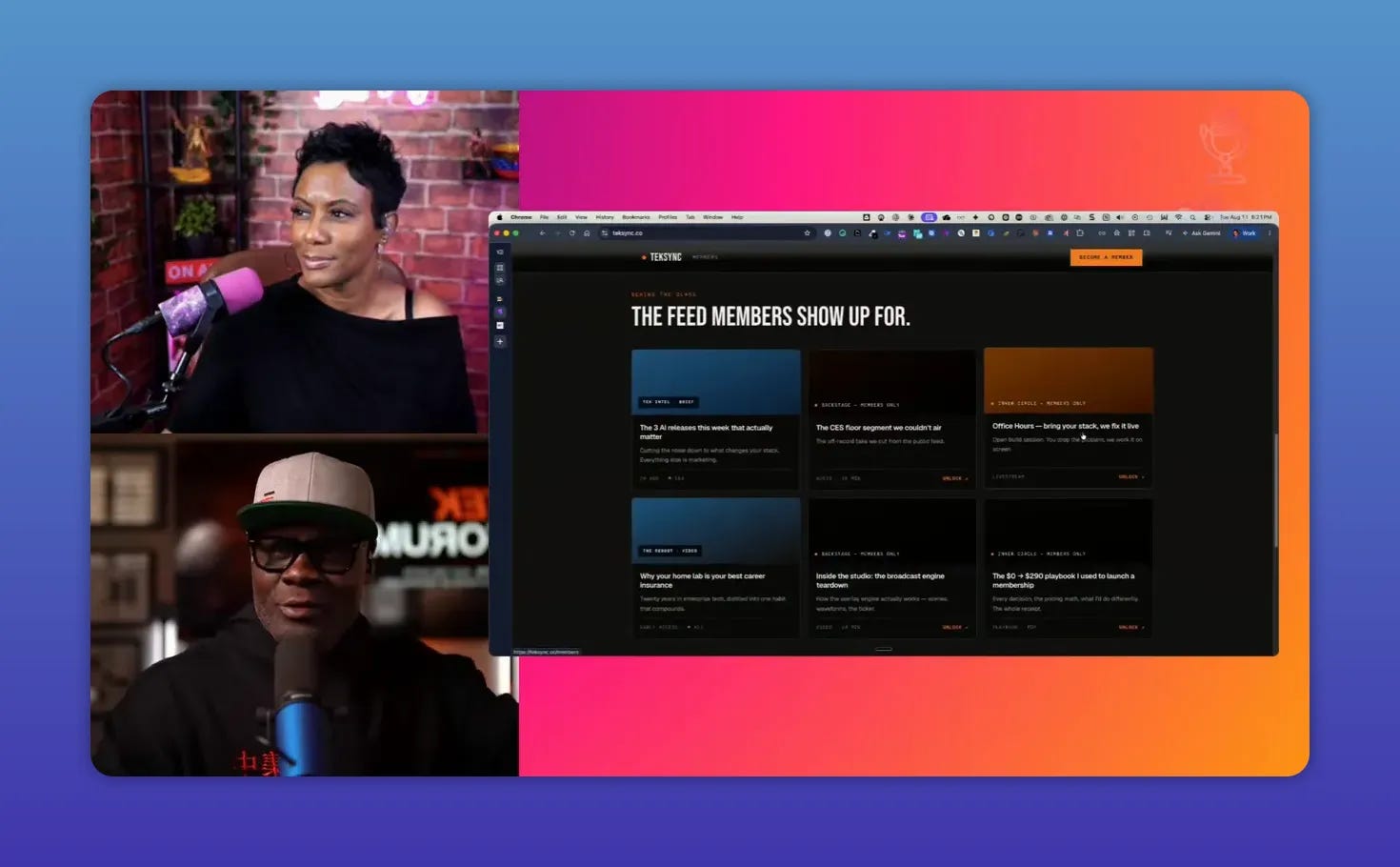
Asynchronous communication is especially valuable. Not everybody is available at the same time, and not everybody prefers to write a long message. When people can communicate through audio and video, they can share ideas in the format that works best for them.
A stronger community platform can support:
Tiered access to content and deeper conversations
Audio and video messages
One-to-one and group communication
Branded workshop and session spaces
Horizontal and vertical video creation
Cross-platform access for iOS, Android, desktop, and mobile web
The point is not to make things complicated. The point is to remove friction and give people a practical path from where they are to where they are trying to go.
Use Industry-Standard Infrastructure
Be careful about building your entire business on a trendy tool simply because it has a lifetime deal or looks exciting this week.
The pace of technology is fast. Products change. Platforms get acquired. Companies shut down. Pricing changes. Features disappear. If your entire operation lives inside one closed container, you can be left scrambling when that container changes the rules.
Build on foundations that give you flexibility. That can include industry-standard tools and services such as GitHub, Netlify, Supabase, established cloud infrastructure, and portable codebases. The specific stack will depend on the product, but the principle remains the same: do not hand over total control of your business to a platform you do not own.
Own your destination whenever possible. Your website should be more than a link in a social bio. It should be the home base where your brand, resources, content, email strategy, and customer relationships can live.
You can still benefit from YouTube, social platforms, affiliate programs, and third-party marketplaces. But build your own real estate around them. If an algorithm changes, your business should not disappear with it.
AI Should Be a Member of the Team, Not the Team
AI is powerful as an idea partner, research assistant, first-draft writer, coding collaborator, and thought challenger. It should not be the final decision-maker.
A practical approach is to ask the same question across more than one AI platform, compare the answers, and then weigh them against your own experience and conversations with real people.
That is the key: use AI as one voice in the room, not the only voice in the room.
It is also smart to ask your AI tools to challenge you. Do not prompt them only to agree with your first idea. Ask for criticism. Ask what you are missing. Ask what could fail. Ask how a customer might misunderstand the product. Ask what security or scalability concerns should be addressed.
Better still, surround yourself with real people who will tell you the truth. You need people who will say the overlay needs work, the messaging is unclear, the pricing does not make sense, or the product is not ready yet.
Do not build a room full of yes people. You need people willing to tell you when your baby is ugly.
Validate, Test, Break It, Then Rebuild It
The first version is not the final version. It should not be.
Products get better through feedback, testing, iteration, and honest conversations. Put your solution in front of a small group of trusted people. Ask them to use it the way they actually would. Ask them to break it. Pay attention to where they get confused, where they hesitate, and what they ask for next.
That feedback loop is how you move from a nice idea to something durable.
A solid validation process looks like this:
Identify the problem: Start with a pain point you have personally experienced or deeply understand.
Talk to potential users: Confirm that the problem exists beyond your own situation.
Define the smallest useful version: Build the minimum capability that creates real value.
Test with a trusted group: Give people permission to be honest and break things.
Iterate: Fix the weak spots, clarify the experience, and improve the workflow.
Evaluate the business model: Decide whether the solution is a product, a service, a lead magnet, an internal tool, or something that should be retired.
And yes, sometimes the right move is to pivot. You may discover that you do not want to be in the SaaS business. You may realize a tool is not aligned with your actual purpose. You may find that a product idea does not solve a problem people are willing to pay to solve.
That is not failure. That is due diligence.
Do Not Confuse a Quick Launch With a Sustainable Business
There are people who believe a few prompts, a landing page, and a payment link will make them an overnight success. That is not how durable businesses work.
Building something valuable is a marathon. It takes ongoing learning, attention to detail, customer feedback, and a willingness to do the less glamorous work behind the scenes.
People pay attention to what they pay for. If you are asking somebody to trust your product with their time, data, or money, it needs to deliver genuine value. The solution must be something you would feel comfortable putting in the hands of the people you care about.
That is why transparency matters too. If you share affiliate tools or recommend products, disclose those relationships and give people the balanced view. The good and the bad both matter. You can find the active commercial relationship disclosures at the HicksNewMedia transparency log.
Build Your Own Authority Instead of Borrowing It
As more people gain access to AI tools, there will be more noise, more generic solutions, and more folks claiming expertise they have not earned. That makes real knowledge more valuable, not less.
Do the work. Learn the foundations. Study the systems you are discussing. Build your own intelligence around the field you claim to serve. If you are a coach, consultant, creator, or business owner, be able to explain why a solution works, where it is limited, and what is happening under the hood.
You can only fake it for so long. People can research. They can check your history, your work, your receipts, and the quality of what you have actually built.
The people who will last are the people who:
Continue learning
Build with real purpose
Understand the underlying technology
Deliver on what they promise
Welcome informed criticism
Create value for people beyond themselves
Write the Plan Before You Start Prompting
Before you open another AI tool, write down the plan.
Not just in a digital note that gets buried under a hundred other notes. Grab a pen and paper. Use a notebook. Use the back of a napkin if that is what is nearby. Get the idea out of your head and into a form you can examine, question, mark up, and improve.
Write down:
The problem you want to solve
The person you are solving it for
The result you want them to achieve
The current process they are struggling with
The minimum experience your solution needs to provide
The data, security, and privacy considerations
The tools and infrastructure you will rely on
The feedback you need before launch
The outcome that would tell you the project is working
Start broad, then get specific. Prompt the tools. Ask questions. Learn as you go. But do not let the tool drive the vision.
The Bottom Line: Build Something That Matters
This is a great time to build. The tools are accessible. Many are free or low cost. You can create solutions that once seemed out of reach.
But do not build for the quick buck. Do not build just to say you built an app. Do not build a tent when you have the opportunity to build something that can stand.
Build with intent. Build with security. Build for scale. Build for the people who need the solution. Build with enough humility to ask for help and enough confidence to keep learning.
Most importantly, build something that matters not only to you, but to the people you are called to serve.