
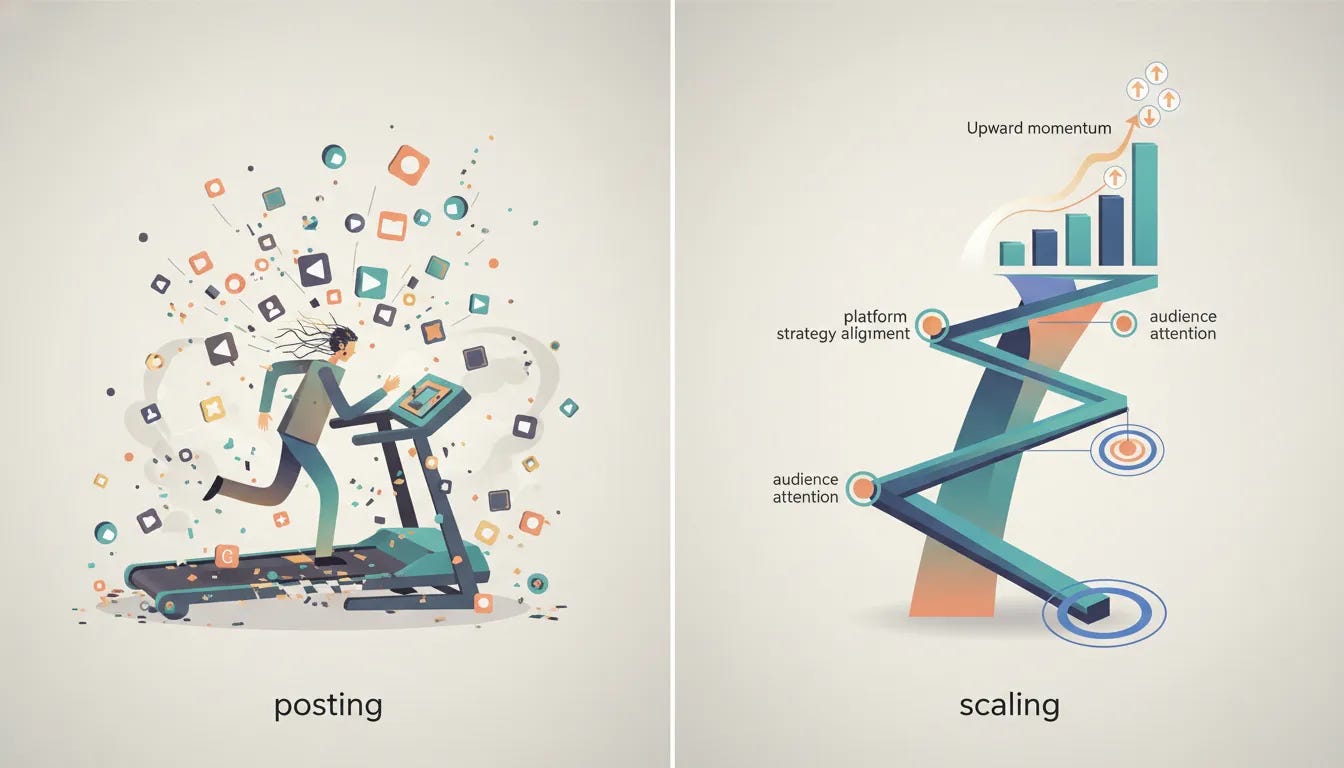
Scaling vs. Posting: Why You’re Losing Money on Social Media
A lot of people are still treating social media like a content treadmill.
Post more. Clip more. Show up everywhere. Push harder.
And then they wonder why the reach is inconsistent, the sales are soft, and the business still feels scattered.
That is usually not a posting problem.
It is a platform strategy problem.
If your content is not meeting the right people where they already spend time, you are not scaling. You are just publishing. And there is a real difference between the two.
The bigger lesson here is simple. Online business growth comes from alignment. Alignment between your audience, your platforms, your offers, your workflow, and the tools you trust to help you execute.
Posting everywhere is not the same as building a system
One of the easiest ways to lose money on social media is to confuse activity with momentum.
There was a point where everything felt scrambled. Too many tools. Too many funnels. Too many call-to-actions. Too many disconnected systems pointing to places they should not have been pointing.
That kind of setup looks productive from the outside, but behind the scenes it creates friction everywhere:
Your audience does not know what to do next
Your content does not lead naturally into your offer
Your tools cost more than the value they create
Your workflow becomes harder instead of easier
Your messaging gets split across too many channels
That is not scale. That is drag.
Real scale happens when the moving parts start working together. Your content should lead somewhere intentional. Your software stack should remove steps, not add them. Your audience should be able to find you where it makes sense for them, not where you wish they would be.
Meet your audience where they are, not where your ego wants them to be
This is where a lot of creators and business owners get it wrong.
Everybody wants to be on the newest platform. Everybody wants to chase the exciting platform. Everybody wants to be early.
That is fine if you are experimenting.
It is not fine if you are trying to build a business.
If the people who actually buy from you are on Facebook, LinkedIn, or YouTube, then that is where your energy should go. Not because those platforms are flashy, but because that is where your people are.
That was one of the clearest business points that came out of this whole conversation. For some audiences, especially older and more established ones, Facebook and LinkedIn still matter a lot. They are not sexy answers, but they are practical ones.
And practical usually pays better.
Why this matters for online business
Different platforms do different jobs.
YouTube is where long-term searchable content lives
Facebook can help you reach established communities and familiar networks
LinkedIn is strong for business relationships, authority, and professional discovery
Instagram is useful as a visual business card, but not always the best home for deep discoverability
TikTok may be great for attention, but not every audience lives there, and not every creator wants to build there
The key is not being everywhere. The key is knowing which platform houses your content, which platform drives discovery, and which platform actually converts.
Searchability matters more than people admit
One of the most overlooked parts of social media strategy is this: some platforms are built for now, and some are built for later.
That distinction matters.
If somebody can search your name, your topic, or your show six months from now and still find your content, that content keeps working.
If a platform buries it, expires it, or makes it difficult to surface later, then your content has a much shorter business life.
That is one reason YouTube still holds so much weight. A live stream, a tutorial, an interview, a breakdown, or a thought piece can continue generating traffic long after it goes live.
Compare that to platforms where live content disappears, gets deprioritized fast, or is hard to find later. Those platforms can still serve a purpose, but usually that purpose is awareness, not long-term asset building.
So if you are spending hours producing content, ask yourself a blunt question:
Am I creating an asset, or am I just making noise for the next 24 hours?
Too many tools will bury your margin
This is another place people leak money.
There is no shortage of AI tools, video tools, productivity apps, and social media helpers. The problem is not that the tools exist. The problem is paying for a pile of tools that do not actually fit your workflow.
That is how your software stack starts eating your profit.
Sometimes the outlay is real. The subscriptions pile up. The promises sound great. The onboarding looks clean. Then the tool underdelivers, breaks, or adds complexity where it was supposed to save time.
That is why being a generalist forever eventually stops making sense. At some point you have to narrow down and say:
What actually works?
What do I trust?
What would I put my name behind?
What reduces steps in the workflow?
What is solving a real business problem?
That shift from “try everything” to “use what works” is a maturity move.
And honestly, it is one of the best things you can do if you are serious about scaling instead of endlessly tinkering.
The right tool is the one that helps you reflect, decide, and move faster
A good example of this is productivity software that does more than just hold tasks.
One of the more impressive tools discussed was Littlebird, a cross-platform assistant available on Mac, Windows, iOS, and Android. What makes it interesting is not some inflated marketing headline. It is the fact that it actually consolidates work activity in a way that is useful.
Calendar events, reminders, meetings, notes, routines, journal entries, project context, integrations, transcription, summaries. It pulls from the places where work is already happening and turns that into something you can ask questions about.
That matters when your days are full and your brain is already juggling too much.
Why tools like this matter for business owners
If you are someone who plans tomorrow before you go to bed, writes down the top priorities, and tries to “eat the frog” first thing in the morning, then a tool like this supports the discipline you already have.
It helps answer questions like:
What did I actually get done last week?
What is still open?
What happened in that meeting?
What is on my schedule this week?
Where did my time actually go?
That is useful not just for productivity, but for business decision-making.
Because when you can see where your effort is going, you can start noticing where your money is leaking too.
What stood out about Littlebird
It surfaced work activity with surprising detail
It supported Apple Calendar and Apple Reminders, which a lot of tools ignore
It connected with tools like Google Calendar, Notion, Asana, Calendly, and ClickUp
It handled meeting notes, transcription, audio, and video summaries
It leaned into conversational use, including mobile use
It emphasized security with certifications like HIPAA and SOC 2
That kind of visibility can feel almost scary the first time you see it summarize your week back to you. But it is also a reminder: if your systems are connected well, they can become genuinely helpful.
AI is powerful, but knowing when not to use it matters just as much
This is the part that needs more honesty in the business conversation.
AI is not magic. It is not automatically worth every subscription. It is not always the answer. And if you give too much away to automation without enough judgment, it will absolutely bite you.
That is why the smarter conversation is not “AI or no AI.”
The smarter conversation is when to use autonomy and when to step in front.
That is the real skill.
There is a balance between letting the tools help and making sure they are not leading the business somewhere you did not intend to go. That applies to:
content creation
branding
editing
scheduling
research
communication
image generation
workflow automation
AI can absolutely accelerate things. But it can also create more noise, more cost, and more bad output if you are not careful.
So no, the answer is not to avoid it entirely. The answer is to use it with discernment.
Specialization beats endless experimentation
There comes a point where trying every app under the sun stops being helpful.
You spend too much time learning interfaces, comparing plans, chasing updates, and rebuilding systems that did not need rebuilding in the first place.
That is when specialization starts to win.
Not specialization in the sense of becoming narrow-minded. Specialization in the sense of choosing a small set of proven tools and getting extremely good at using them.
The stack that was highlighted was not random. It reflected that exact shift:
Claude as a preferred LLM for many tasks
Notion without the added AI tier, since Claude handled that side well enough
CapCut for fast, effective editing
Riverside for titles, descriptions, summaries, highlights, and workflow efficiency
vidIQ for thumbnails, tags, title updates, and refreshing older YouTube assets
That is not just a list of apps. It is a philosophy.
Use what earns its keep.
Why Riverside made sense as a business decision
One of the strongest examples of choosing function over hype was the comparison between Riverside and Descript.
The issue was not whether Descript is good. It is. The issue was value relative to actual need.
When you are producing multiple shows a month, running transcriptions constantly, creating highlight reels, writing descriptions, and generating assets, pricing starts to matter fast.
Riverside stood out because it could handle:
text-based editing
highlight creation
titles and descriptions
summaries
mobile content capture
multi-person recording
podcast distribution support
And for that use case, it did enough of what was needed at a lower monthly cost.
That is a business move. Not a fanboy move. Not a trend move. A business move.
Old content is money too if you optimize it
Another smart takeaway came from the way vidIQ was being used.
A lot of people post a video and then never touch it again. That is lazy money.
There is value in going back through your library and improving what already exists:
update weak titles
add missing tags
refresh thumbnails
strengthen SEO
improve discoverability on older content
That is one of the easiest ways to make your content library work harder without having to create something brand new every single time.
The idea of logging in daily, checking title suggestions, reviewing older videos, and applying stronger metadata is not glamorous. But that kind of maintenance is part of scaling a content business.
Your branding should evolve as your standards rise
There was also a useful conversation around merch, branding, and presentation, and the lesson there applies beyond apparel.
As your business matures, your quality standards should rise with it.
That could mean:
better thumbnails
cleaner wordmarks
stronger visual consistency
higher quality products
more thoughtful offers
less ego-driven branding and more universal branding
Not everybody wants to wear a shirt with your name on it. Fair enough.
But they may support a stronger symbol, a more flexible brand mark, or a message they connect with.
That is a useful reminder for social media too. Sometimes the goal is not to push more of you. Sometimes it is to package the idea in a way that is easier for people to connect with.
If you create content, quality compounds over time
One of the best parts of the broader conversation was seeing how content quality evolves.
Not overnight. Over time.
There was a great example in the progression of a show’s thumbnails and intro assets. Early versions were fine for where things started. Then over time the look sharpened:
more contrast
more cinematic framing
better templates
stronger AI-assisted visuals
clearer identity
That is worth remembering if you are still waiting for perfect.
Perfect is not the requirement. Progress is.
You start with the best version you can make today, then you improve it as your eye, your tools, and your standards get better.
AI content tools are getting wild, but they still require judgment
The conversation also moved into creative AI tools like Higgsfield, ChatGPT image generation, Gemini, and video tools built around motion control, scene generation, and character-based outputs.
And yes, some of this stuff is getting crazy good.
You can build animated intros, visual segments, UGC-style outputs, stylized imagery, and sequence-based storyboards with a speed that would have sounded ridiculous not long ago.
But two things still matter:
The credits cost real money
Bad prompts waste those credits fast
That is where people get caught.
They see the shiny output and forget the economics behind it. If you are not careful, these tools become another expensive hobby disguised as innovation.
So if you are getting into advanced AI creation, be smart:
Know what outcome you want before you generate
Check your prompt twice
Understand the credit model
Move fast, but do not move sloppy
Use the right model for the right task
You do not have to do everything yourself
This may be the most practical scaling point in the whole conversation.
If someone else already knows how to do the thing well, there is no prize for struggling alone.
Sometimes the better move is to:
hire the expert
barter with someone in your network
trade skills
lean into community
collaborate instead of collecting more subscriptions
That applies to AI workflows, video production, design, automation, strategy, and more.
There was a strong point made about this through the idea of a collective. Everybody brings something different. One person is great at editing. Another is strong in strategy. Another knows systems. Another knows visuals. Another knows live production.
When people work in their strengths, everybody moves farther, faster.
That is scaling too.
So where should you actually focus?
If your business feels scattered right now, here is the practical reset:
Figure out where your target audience really is.
Not where the noise is. Not where the hype is. Where your buyers are.Choose platform roles.
Decide where content lives, where it gets discovered, and where it converts.Audit your tool stack.
Cut the apps that add cost without adding leverage.Build around a few trusted tools.
Get better at the ones that actually support your workflow.Optimize your old content.
Titles, thumbnails, tags, descriptions, all of it matters.Use AI with intention.
Let it help, but do not let it run wild without oversight.Collaborate where it makes sense.
Stop trying to be the entire production team if you do not need to be.
The real reason you’re losing money on social media
It usually is not because you are not posting enough.
It is because too much of your effort is disconnected from your audience, your business model, or your actual goals.
Social media can absolutely expand your reach and grow your business.
But only if you stop treating every platform the same, stop paying for every shiny tool, and stop confusing visibility with strategy.
Meet people where they are. Build systems that make sense. Use tools that earn their place. And keep tightening the connection between your content and your business.
That is how you stop just posting and start scaling.


