
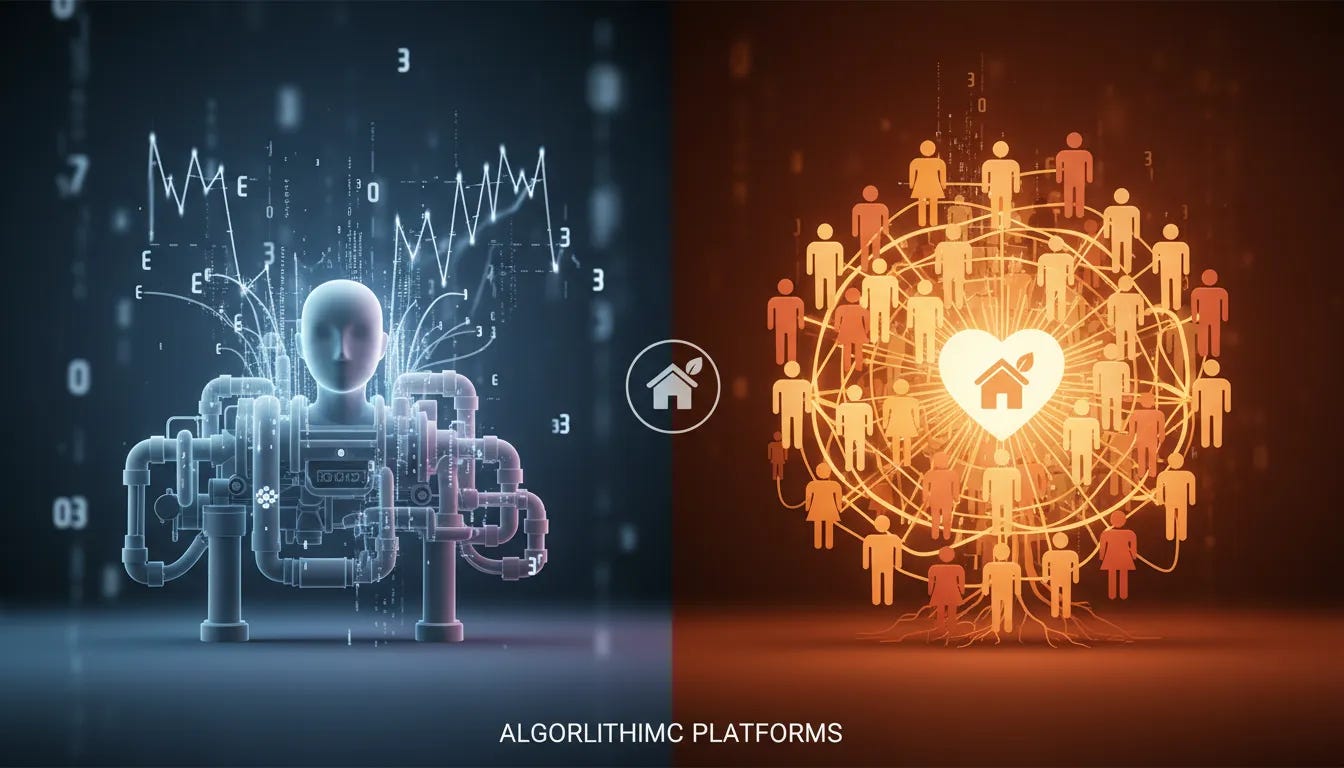
Stop Relying on the Algorithm: How to Reach Your Community Everywhere
Algorithms are useful. But treating them like your business infrastructure is how you end up on rented land.
In a world where platforms change ranking systems overnight, the real power is building community connections that are reliable, repeatable, and yours. That means showing up where it makes sense, building owned channels, and using tools like AI the right way. Not to replace real conversation. To support it.
If you want a simple rule: don’t build your whole business on something you don’t control.
Algorithms are third-party infrastructure, not community
From an IT mindset, the takeaway is straightforward: if the foundation is owned by someone else, your stability depends on their rules.
That’s why creators discussed “getting off rented land” and building channels where they have a mortgage-like relationship to the outcome. Live streams, social platforms, and discovery feeds can still be part of your strategy. They just shouldn’t be your only plan.
Reach your community where they already are
One of the most practical questions raised was: What are you doing to reach your community where they already spend time?
The answer is not “post everywhere” randomly. It is about choosing platforms on purpose, then linking everything back to your central mission.
Pick platforms as funnels, not decoration
Gabe’s point was sharp: if you’re “spreading peanut butter,” you’re likely just creating noise. But if each platform becomes a place to funnel people back to your purpose, the same core message can travel across multiple channels without losing meaning.
Florence echoed the same principle: the message can be adapted for different formats, but the purpose stays consistent. You’re not chasing popularity. You’re serving a specific person with specific friction points.
Maintain direct communication through owned channels
Instead of relying solely on public feeds, many creators built “back channels” that allow direct connection.
Email lists for people who want to hear from you without platform interference
Newsletters and writing-based platforms like Substack
Community spaces (example mentioned: Skool / “school” environment)
Build an owned content ecosystem (email, newsletter, community)
Live streams can be “top of the funnel.” They pull in prospects. But owned platforms are what stabilize the relationship.
One creator described this as email list as primary and secondary, then routing people back and forth between:
Email to community
Community back to email
Public platforms as an additional layer when people are already there
The point is not to abandon YouTube or social platforms. The point is to keep control of the conversation so your audience is not dependent on someone else’s feed.
Use the same message, different packaging
Content ecosystems often work better when you stop thinking “Do I have to reinvent myself for every platform?” and start thinking “How do I translate my message to each format?”
That was the key distinction emphasized:
Use the same pillars and purpose
Change the format, tone, and outcome based on where people are
Keep the reason you’re posting the same: serve real humans, solve real friction
That’s how you show up consistently without burning out or sounding like a copy-paste account.
Don’t “chase checkmarks.” Chase trust and value.
There was a strong pushback against metrics that create vanity pressure.
For example, Gabe treated “recognition” and platform badges as secondary to value. Followers and verification can matter to some decision makers, but real credibility still comes from:
Word of mouth from real people who have seen you deliver
Consistency in sharing what you know
Evidence that your work helps someone move forward
One way to interpret this is simple: you can be authentic and still be intentional. You do not need a popularity contest to build a community.
What “community” actually means
When the discussion got specific, “community” was defined less by dashboards and more by fellowship.
Real community shows up as:
Live engagement where someone is actually there with you
Back-channel connection so members can keep talking offline
Vulnerability (including admitting mistakes and learning in public)
Collaboration where members bring solutions and examples from their real businesses
Florence’s perspective was especially direct: community isn’t new. Humans have always built community through shared stories, victories, failures, and lessons. What changes is the packaging.
AI should amplify real connection, not replace it
AI was discussed in two modes: as a helpful shortcut and as a potential isolation machine.
Shortcut vs. isolation
The warning was that desperation to “get more output” can create unhealthy patterns. If the goal becomes vanity metrics rather than real conversation, AI becomes a way to avoid vulnerability and interaction.
Gabe and Florence also highlighted an important nuance: people throw “AI” around as one concept, but they should understand what they’re using.
Use AI to remove friction, not remove people
Florence described using AI differently than the typical “write the post for me” approach. Instead, she uses AI to:
Challenge her thinking
Look for gaps in understanding
Test logic before posting
She made the argument that her 1,440 minutes a day are valuable. If she already knows her message and purpose, feeding an LLM to “understand her” is not a productive use of time.
Use AI to structure when you’re stuck
Gabe’s “devil’s advocate” response was practical: even if you struggle writing, AI can help flush out ideas, provide structure, and create a path forward. The output still belongs to you because your perspective is the soul of the work.
In other words: AI can help you un-block. It doesn’t replace your voice.
Weekly content loops that keep your wheel turning
The session ended by getting into systems. Not vague motivation. Repeatable weekly routines.
Here are several “content loops” reflected across the discussion.
Loop 1: Choose your platforms, then show up with focus
Gabe described double-down behavior: if a platform isn’t aligned with his pillars, he doesn’t spend time there. He even deleted a TikTok audience because it didn’t match who he was trying to reach.
Weekly rule:
Pick your “home bases” (where your ideal people actually engage)
Post consistently inside those formats
Stop doing platforms that create burnout without returns
Loop 2: Build owned assets, then distribute
Instead of constantly starting from scratch, create assets that persist:
email updates
newsletter recaps
community posts
blog or Substack-style writing
Then use public platforms to point people back to what you own.
Loop 3: Pre-write and schedule to protect your time
Florence and Gabe emphasized planning ahead so you are not scrambling every week. One example mentioned: writing community posts for 52 weeks in advance, then using pre-built scheduling so posting becomes “just posting.”
Weekly rule:
Set a content calendar
Write in batches
Schedule future drops so your energy stays where it matters
Loop 4: Use workflows and templates (so you eliminate steps)
Florence described a workflow approach built around:
templates so you don’t recreate everything
stream deck automation to reduce clicking and switching
a database of “friction” problems so issues get solved systematically
The goal of automation is simple: fewer steps, more consistency, less burnout.
Loop 5: Make the community interactive, not transactional
Gabe’s community takeaway was clear: aim for committed people over massive numbers. Live engagement, back channels, and inclusive conversation create retention.
Weekly rule:
Host live moments where people can talk to you and each other
Invite member participation (collaboration beats broadcasting)
Create a rhythm: a recurring day or event members expect
Stop chasing. Run your own marathon.
The closing message was about identity and purpose, not hacks.
You will get swept if you let your strategy be dictated by whatever platform is trending this week. Your success number is not everyone else’s. It might be a brand partnership. It might be a keynote. It might be building a legacy through community trust.
What matters is staying true to your message and serving your people consistently.
Video
Resources mentioned
Florence: https://florencedonald.live/skool
Quick checklist: build community you control
Own at least one channel (email, newsletter, or community space)
Choose platforms with a purpose (funnel, not random posting)
Keep your message consistent (change packaging by format)
Prioritize trust and engagement over vanity metrics
Use AI as a tool to remove friction, not replace real interaction
Build repeatable weekly loops with scheduling and templates


