
The Revolution Happening in Creator Economy Right Now
Move From Tenant to Owner (Audience, Monetization, and Control)
Most creators and digital leaders are fluent in the visible metrics: views, subscribers, likes, revenue, ROI. But there’s a quieter risk that tends to show up after you’ve already built a life around a platform you do not own.
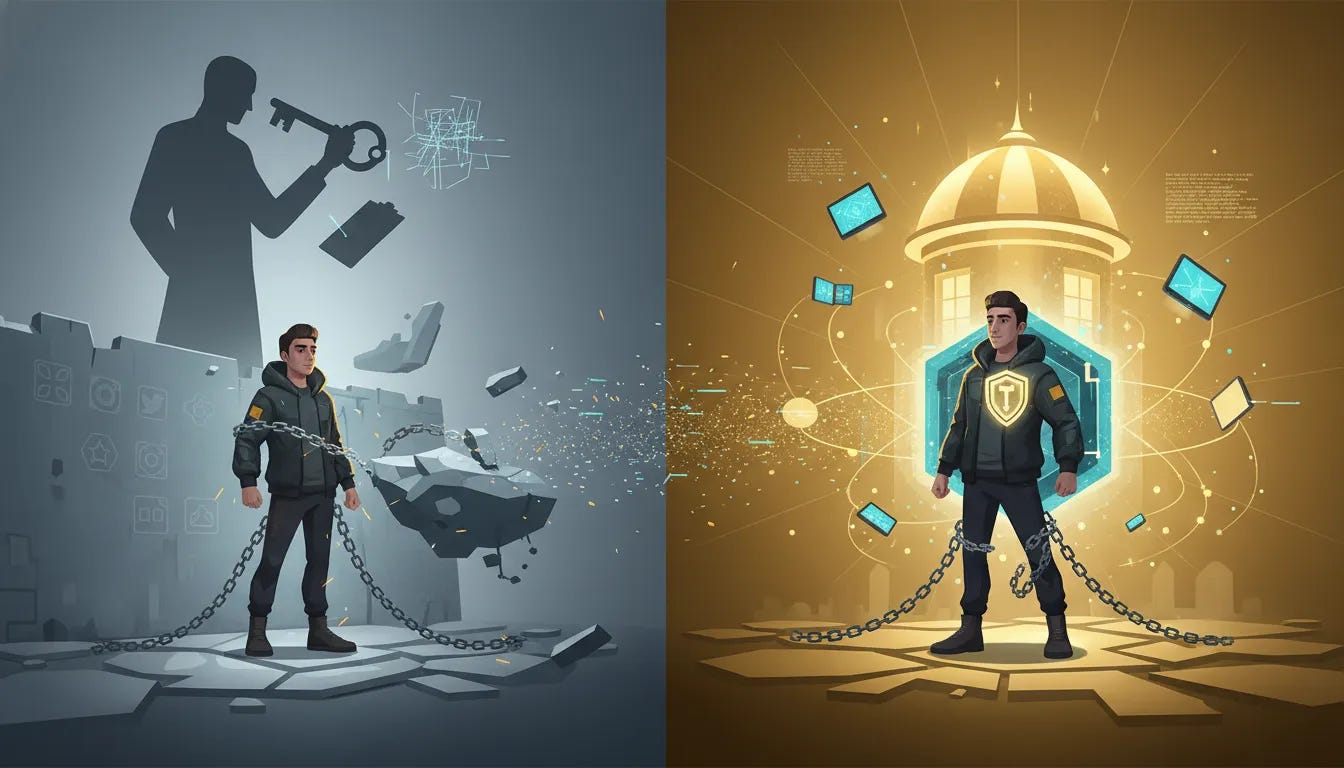
We build our homes on land we rent month to month. TikTok, YouTube, Instagram, Facebook. They help with discovery. They help with growth. They also act like landlords. And landlords can change rules, pivot direction, lock accounts, or simply stop “leasing” to you.
This piece is about audience ownership, the tenant versus owner mindset, and a practical path to regain control. Along the way, we’ll talk about Open Video as a “white-labeled YouTube” style option where creators move video hosting and monetization into their own ecosystem. And we’ll connect that to what’s happening now with AI workflows through MCP (Model Context Protocol).
Digital sharecropping: the hidden risk in creator growth
There’s a term that lands hard when you first hear it: digital sharecropping. The idea is simple. You spend your time and energy building content on someone else’s infrastructure, then discover too late that your business model depends on a landlord you can’t control.
People often learn this the stressful way: accounts get locked, channels get restricted, monetization changes, or policies shift. And by then, you’ve invested in the platform stack instead of the relationship and assets that actually belong to you.
That’s the core shift:
From tenant mindset: “My livelihood depends on the platform.”
To owner mindset: “I control the relationship, the distribution, and the monetization surface area.”
The goal is not to be anti-platform. Platforms are useful. But if your “business” is actually renting your future, you are always one policy change away from losing your foundation.
What’s wrong with focusing only on views and subscribers?
Traditional growth systems push you toward third-party metrics. The most common habit looks like this:
Track views and subscriber counts.
Optimize content for discovery inside a platform’s algorithm.
Hope that monetization unlocks when you hit the requirements.
But the risk is that those numbers can become vanity metrics if you cannot directly reach your audience. It becomes possible to have a large subscriber count and still not have the emails you need, the data you need, or the ownership you need to keep moving.
There’s another layer: platforms are designed to maximize time on site and ad delivery. The platform’s goal is not your goal.
Your goal is to connect with people, build trust, and monetize your work. The platform’s goal is to keep users on the platform so more ads can be served. Even when your content is the reason they attract users, your content can become just one item in a never-ending feed that includes your competitors.
Moving from a rental agreement to a mortgage mindset
Think of it like building a factory. You wouldn’t build a factory on land you pay for month to month. You’d build on land you control so you can grow without constant renegotiation.
In creator terms, that means changing what you treat as “home base.” Instead of assuming YouTube or social channels are the business, you shift your business foundation toward something you can own: your website presence, your video hub, your audience connection points, and your monetization surface.
This is also why the conversation keeps returning to the “mortgage” metaphor. It’s not just romantic. It’s strategic. When you own the asset, your growth becomes less fragile.
Platforms are useful. Ownership is the upgrade.
Let’s be clear. The point is not “quit YouTube” or “stop using social.” Platforms help with distribution and discovery. They’re powerful at getting people to your work.
The point is where those people go next, and who owns what happens after they click.
One common pattern goes like this:
You post on a platform because it’s where attention already is.
Then you send your audience from platform to platform.
Each hop adds friction and adds another layer of “stuff you don’t control.”
When you host and manage your content in an owner-controlled home base, you reduce those hops and strengthen your ability to convert interest into an ongoing relationship.
The creator tax: “free” platforms aren’t free
Social platforms are often described as free because you are not paying money to upload content. But “free” comes with a trade.
The creator tax includes:
Your content is used to power the platform’s engagement.
They monetize through ads and other revenue systems.
Revenue share is usually limited (for example, a 50% split is commonly referenced once you reach partner thresholds).
Rights and takedowns: platforms reserve the right to remove content for policy violations, sometimes without you understanding what triggered the issue.
This is not a reason to panic. It’s a reason to plan. You can leverage platforms for discovery while still building an owned layer for revenue, distribution, and audience connection.
Why “open video” exists: audience ownership, monetization, and discoverability
One of the most concrete tools discussed in this conversation is Open Video. The pitch is straightforward: creators can pull content from YouTube into an owned video hub, so the watch experience lives on the creator’s environment.
Here’s a key point: Open Video is connected to YouTube. It’s not presented as “instead of YouTube.” It’s positioned as a way to keep YouTube for discovery while shifting the hosting and control into your own space.
Core value #1: Audience ownership (not just subscriber counts)
On many platforms, subscribers become a number. You might know a username, but you often do not have direct access to emails or other first-party data that lets you build a stable relationship.
Open Video includes a subscribe button flow where, when someone subscribes on the Open Video channel, the creator receives the email address as part of running their business.
The emphasis is on breaking reliance on the algorithm. If you have email, you can reach your audience when new videos drop, add them to newsletters, and connect without waiting on platform distribution.
Core value #2: Monetization control
Open Video’s monetization concept is built around letting creators run video inventory on their own pages.
In theory, YouTube can show ads on videos and monetize regardless of partner status. But exclusivity and thresholds often limit what creators can earn directly. Open Video instead aims to support a broader model for ad inventory and creator-controlled placement.
One interesting detail mentioned: Open Video is owned by uzoic, which has been in the digital advertising space for about 15 years and has relationships with demand partners. The conversation also references an established place in publisher programs, including being part of Google’s certified publishing partner ecosystem (and the idea that it connects creators to ad demand beyond a single dominant player).
Core value #3: Discoverability beyond YouTube
Search engines have become more picky about ranking video content. A typical embed of a hosted platform video can lead to that hosted platform getting the “juice” for ranking, especially when the video lives elsewhere and is embedded.
Open Video creates dedicated watch pages for each video, optimized to be indexed. That means those watch pages can appear in search results and send traffic to your site’s owned environment.
In practice, the opportunity becomes:
Your video can rank on your site’s watch page.
You might also still appear via YouTube listings.
So you get more than one path to capture search traffic.
The goal is not to abandon YouTube. The goal is to double dip and route viewers back to where you control the experience.
How it works: migrating YouTube content to your owned video hub
Open Video’s migration story is designed to feel low-friction. The “cool” part of the workflow described is that you can:
Connect Open Video to YouTube.
Use an autopilot style action to pull in videos.
Create playlists and arrange your home page.
Brand the experience with your colors and layout.
In the example shown, the interface mimics the YouTube feel: playlists, home page structure, and watch pages with your content rather than other creators’ competing recommendations.
And because it lives on your ecosystem, the hosting environment becomes harder for anyone else to “take away” at the whim of an algorithm update or a policy change.
MCP: using AI agents to automate creator workflows inside your owned stack
Here’s where the conversation gets extra interesting: MCP, short for Model Context Protocol, is described as a way to connect AI agents to tools and interfaces without forcing you to manually click through multiple dashboards.
The framing is like: MCP is a protocol (released by Anthropic in the discussion) that lets clients or agents access capabilities, typically in a way similar to an API, but oriented around letting the model control tasks that normally require human interaction in software UIs.
Practical creator use case: optimize titles, descriptions, categories, keywords, and thumbnails
One example given uses Claude (an AI tool mentioned by name) connected through Open Video’s MCP integration.
The workflow goes like this:
The creator has video content already present in Open Video.
They ask Claude to suggest optimized titles, descriptions, categories, keywords, and thumbnail suggestions.
Claude can then prompt to populate the video details directly in Open Video.
Instead of typing everything by hand, the creator can “go back and forth” and then apply changes.
This is positioned as eliminating a lot of dashboard friction. The creator gives instructions, and the agent executes actions on the owned platform where the video lives.
Real example: karaoke lyrics and bulk video production
A second MCP example is about a CMO (Tyler Bishop, mentioned in the conversation) who started making AI music. The music was then converted into videos with karaoke lyrics because karaoke events required a specific lyric format.
The claim in the discussion is that what could have taken weeks was completed in about 30 minutes for 20 videos, largely through agent-driven automation across systems, with the final step uploading into Open Video.
The headline takeaway for creators: when AI agents can connect to your owned content pipeline, you move from “manual labor” to “prompt-driven workflows.”
Branding matters: the experience should look and feel like you
Ownership isn’t only technical. It’s experiential.
Open Video templates can be customized so the player and page feel branded, including color schemes and playlist structure. That matters because it helps viewers associate the content experience with your personal brand, not a generic platform surface.
When your content “feels like you,” conversions become more likely because trust is reinforced.
Live streaming is coming: monetize your channel page
The discussion also mentions live streaming capabilities as something Open Video is developing. The positioning is that live sessions will appear on your channel page so the monetized experience remains in your owned environment.
It was described as “breaking news” in the conversation, with the note that it was not officially launched at the time but was being developed.
Supporting MCP from your site builder: examples with Manus
MCP is presented as flexible enough to connect through different creator ecosystems. In the conversation, Manus is mentioned, with a demonstration of adding an Open Video MCP connector and configuring it through settings.
The demonstrated workflow included:
Adding the Open Video MCP connector in Manus settings.
Using an interface to list Open Video channels.
Uploading videos either from a local file path or from a public link.
Updating metadata such as title and description.
Setting ad break preferences (for example, after every five minutes) without needing to manually click through a dashboard.
The deeper point is not “Manus only.” The point is that the owner mindset can scale across your workflow tools when MCP makes AI agents capable of interacting with them.
A simple Digital Collective action plan: audit, build home base, connect, and join
If you want a practical path, the conversation ends with a four-step action plan.
1) Do the audit
Look at your top 10 most valuable videos. Choose ones you love and ones with some traction. This helps you identify what to migrate first so you don’t move everything at once.
2) Set up your home base
Decide how you want to structure your owned space, including subdomain versus path decisions (the conversation used the subdomain concept explicitly).
3) Upload your brand kit and pick a hero video
Upload your brand kit so your page feels like you: colors, tone, and the visual identity of your channel. Then choose a hero video that appears front and center.
4) Join the revolution
There is a partnership link referenced in the original conversation, along with an invitation to participate in the Digital Collective community.
Even if you skip the community part, the plan is still useful as a sequence: audit first, move strategically, and build your owned foundation before another algorithm or policy change forces your hand.
Is there a barrier to entry? (Cost, complexity, and setup friction)
One honest question raised in the conversation was whether Open Video has a barrier to entry.
The response emphasized:
Cost: it was described as free at the time of the conversation.
Migration ease: the pull-from-YouTube approach is designed to be simple.
Setup friction: configuration through toggles and link-based setup was described as straightforward.
MCP onboarding: instead of learning complicated dashboards, the idea is that you can have a conversation with your AI agent and execute tasks.
They also addressed future monetization. There were mentions of potential paid features such as paywalls, paid live streaming, and hosting cost-related upgrades. But the “right now” message was: it is free, and it is meant to encourage product adoption early.
Day zero matters: don’t wait for an algorithm change
The owner mindset is often adopted too late because people wait for the moment it becomes painful. But the better strategy is to begin before you need permission to keep your business alive.
That’s the central message:
Don’t rely on rented land for your core growth.
Use platforms for discovery, but build an owned layer for relationships and monetization.
As AI workflows accelerate, connect your owned platform to your agents so tasks happen behind the scenes.
Build on something you control. Then let discovery do its job. Your relationship and monetization surface stay yours.
Get started: migrate the videos you care about first
If you’re unsure where to begin, the “homework” principle is the easiest entry point: take your top 10 valuable videos, select a playlist or individual videos, and migrate the portion that matters most first.
Once your owned hub exists, you can keep improving it: add brand kit, refine SEO watch pages, set up email capture, and connect AI through MCP so optimization becomes less manual.
That is what the creator economy revolution looks like in real time: more autonomy, more control, and fewer landlord surprises.


