The magic trick phase of AI is over.
We have already done the fun part. The clever thumbnails. The goofy image generations. The quick-hit prompts that made everybody say, “Whoa, that’s crazy.” That season mattered because it got people’s attention. But that is not where the real story is anymore.
Now we are in a different era. AI is moving from sidekick to operator. From novelty to infrastructure. From helping you make content to helping you run the business behind the content.
That shift matters a lot if you are a creator, solopreneur, podcaster, educator, or anyone trying to build something without a giant team.
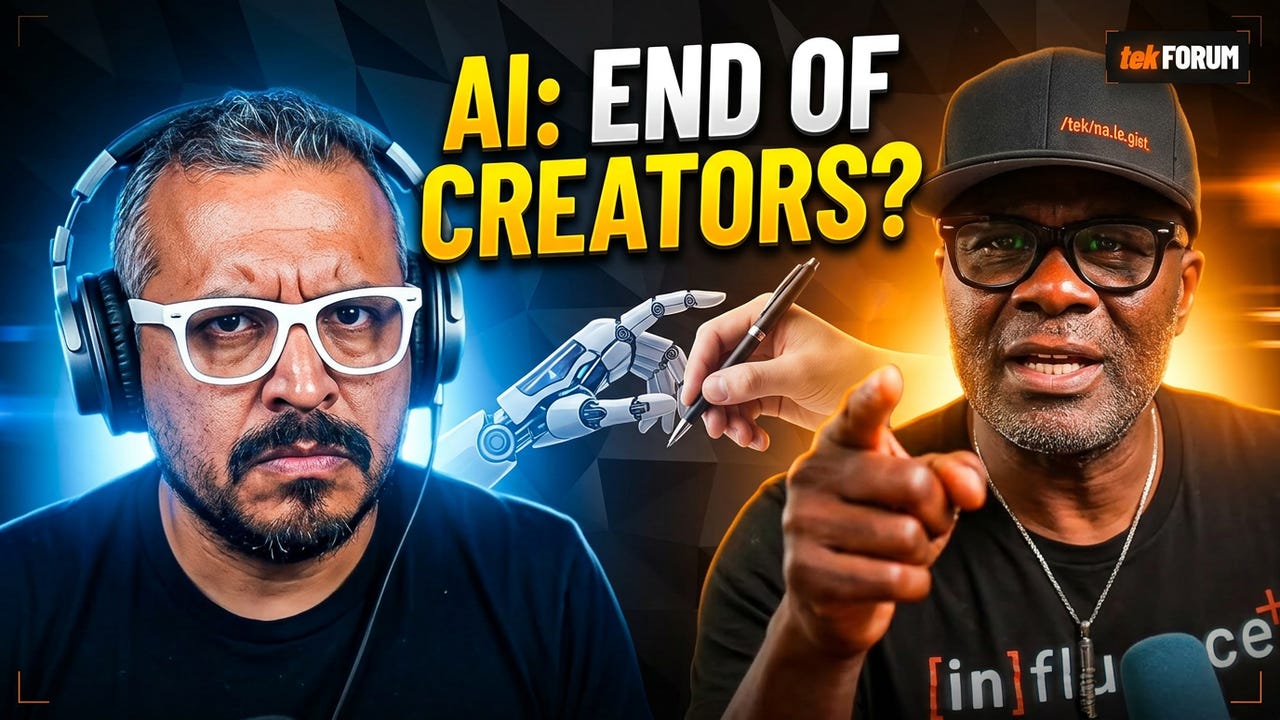
The real question now is not whether AI can make something cool. The real question is this: is AI creating a creator revolution, or is it replacing creators altogether?
The magic phase is over. We are in the systems phase now.
The old conversation around generative AI was mostly about output. Make an image. Write a caption. Draft an email. Generate a script. Create a song. Build a logo.
Useful? Sure.
But where things have really changed is in operations.
For a lot of creators, the bigger unlock is not a prettier output. It is a smoother workflow. It is removing friction from the front end and the back end of the business. It is reducing the amount of time spent on repetitive admin, setup, distribution, editing, follow-up, and scheduling.
That is where agentic AI enters the conversation. Not as a chatbot you occasionally ask for help, but as a set of systems that can support, route, automate, and coordinate work across your stack.
That is a very different mindset.
You are no longer just prompting a tool. You are starting to manage a digital workforce.
The most underrated way AI saves time for solopreneurs
One of the clearest examples came through the lens of podcasting.
Launching a podcast sounds simple until you actually do it. The conversation itself might be the fun part, but everything surrounding that conversation can eat your week alive.
Think about what has to happen before and after one episode:
Guest outreach
Booking and scheduling
Prep questions
Recording logistics
Editing
Clip creation
Show notes
Social media distribution
Follow-up emails
Lead capture and funnel routing
Before AI-driven workflows, those tasks could take hours. Sometimes days. Now, with the right setup, a lot of that can be compressed into a single session.
That is not hype. That is operations.
For a solo entrepreneur, that changes the game because the work stops being “do every single task manually” and starts becoming “design the system once, then improve it.”
The work becomes the conversation, the teaching, the thinking, the relationship-building. The machine support handles more of the repetitive production load.
Why so many creators are still fighting AI
Even with all that upside, plenty of creators are still resisting.
Some of that resistance is technical. A lot of it is emotional. And honestly, a good chunk of it is moral.
For many people, AI feels like cheating. For others, it feels like theft. For some, it feels like an existential threat to the skills they spent years building.
That concern is not imaginary.
If you are a graphic designer and suddenly someone can create usable visuals with a few prompts, that hits differently. If you are a musician and AI tools can generate commercial-use tracks, that changes the economics of your craft. If you are a writer, editor, voice actor, or producer, AI does not feel abstract. It feels personal.
That is why conversations around AI often get heated fast. People are not only debating tools. They are protecting identity, labor, and livelihood.
And they should be allowed to feel that tension.
At the same time, the technology is not going away. So the practical question becomes: how do you engage it without letting it erase what makes your work matter?
Where is the human in all this?
This is the question that matters most.
If AI can create faceless YouTube channels, generate podcast scripts, clone voices, automate editing, and draft courses, where exactly does the human element still live?
The answer is simpler than people think.
The human is in the conversation.
The human is in the decision-making. In the taste. In the discernment. In the lived experience. In the ability to listen, respond, adapt, and connect.
AI can simulate structure. It can accelerate production. It can support delivery. But the actual spark that makes content resonate still comes from people who care about what they are saying and who they are saying it to.
That is why live conversation still matters. That is why storytelling still matters. That is why personality still matters. That is why mistakes, nuance, timing, humor, and real exchange still matter.
The human element has not disappeared. It has become more important because generic output is now cheap.
System vs. workflow: a useful distinction creators should understand
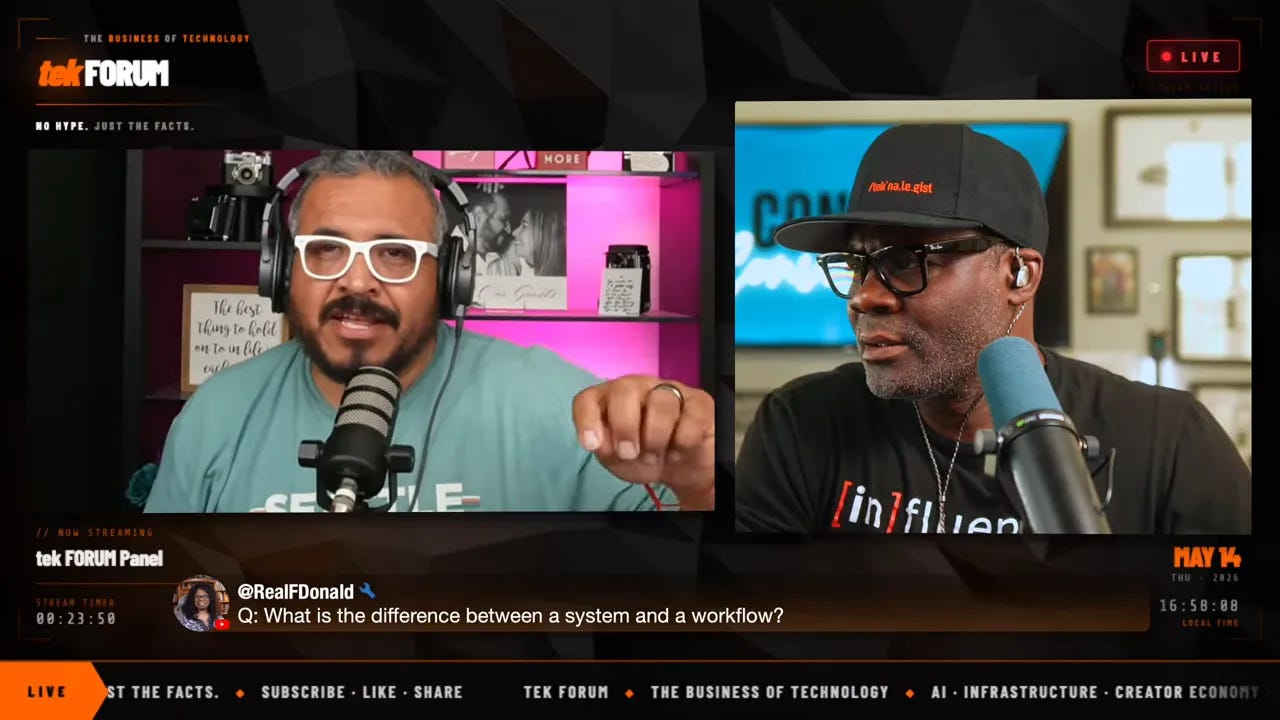
One of the most useful parts of the conversation was the distinction between a system and a workflow.
What is a system?
A system is the full infrastructure that moves someone from one stage to the next.
For example, in podcasting, a system might include:
A guest invitation link
An intake form
Automatic booking
Question generation
Email reminders
Recording links
Editing handoff
Social distribution
Follow-up communication
That is the end-to-end machine. Front end to back end.
What is a workflow?
A workflow is the process inside the system. It is how the content actually gets planned and produced.
That might mean:
Building out 10 weeks of content
Organizing content pillars
Tracking guest confirmations
Moving each episode into production at the right time
Following a repeatable publishing rhythm
That distinction matters because a lot of creators are trying to fix a workflow problem when what they really need is a system. Others build a fancy system without ever defining the workflow that gives it direction.
A practical example of AI in a podcast business
Here is what an AI-supported creator operation can look like in practice.
Say someone wants to start a podcast or learn about podcasting. AI can help route that person into the right next step without constant manual intervention.
They fill out a form or click a booking link
They get entered into an email sequence
They receive information about services, school, or training
They are guided to podcast episodes or learning material
They can schedule sessions automatically
In some cases, they can even call a voice agent for information
On the back end, once an episode is recorded, AI can assist with:
Quick editing
Clip extraction
Social post prep
Distribution across platforms like LinkedIn and Instagram
That does not mean the creator is absent. It means the creator has chosen where to stay human and where to reduce drag.
That is the real operational advantage.
Using AI selfishly is not a bad thing
There was a refreshingly honest point made during the discussion: not everyone using AI wants to become an AI educator.
Some people do not want to teach prompt engineering. They do not want to sell a five-thousand-dollar course about becoming an AI expert. They are not trying to become the next loud voice in the “AI guru” economy.
Some people are just using the tools to make their own lives easier.
That is valid.
There is room for educators who teach the mechanics and room for practitioners who simply use the tech to serve their own mission better.
That distinction is important because it keeps the conversation grounded. Not every creator needs to become a public AI strategist. Sometimes the goal is straightforward: save time, reduce friction, and focus more energy on the work that matters most.
Should you learn the hard way first?
This is where things get nuanced.
If you want to build a course from scratch, write your own outlines, learn the skill deeply, and understand every layer of the craft, that is a great choice.
If you want AI to accelerate the process because you still have value to share but not enough time to build every piece manually, that can also be a valid choice.
The key is not whether AI touched the process. The key is whether your thinking disappeared from it.
That is the line.
AI can help with ideation, structure, rough frameworks, and organization. But if the final deliverable has no trace of your judgment, your experience, your standards, or your voice, then the value starts to collapse.
Use the tools. Just do not outsource your mind.
How to prompt better without wasting time and tokens
Prompting still matters, even as AI tools become more polished.
One practical recommendation stood out: keep a catalog of your prompts.
That means saving what worked, what failed, and what needed revision. This helps for two reasons:
You develop your own prompt library over time.
You stop burning usage limits on vague or repetitive trial-and-error.
As models become more powerful, they also become more expensive in terms of usage, context windows, and token consumption. If your prompt is muddy, the system has to do more work, and you pay for that in time or limits.
A smarter process looks like this:
Write down your objective first.
Clarify what outcome you actually want.
Review old prompts that worked on similar tasks.
Test and refine in lower-stakes tools if needed.
Then run the improved version in your preferred model.
This is not glamorous, but it is how you get better results.
Are AI aggregators helping or hurting?
Tools that bundle multiple large language models into one interface are becoming more common. They promise convenience. Less setup. Less manual prompting. More built-in agent behavior.
That can absolutely save time.
But it also raises a bigger question: are we moving in the right direction?
The honest answer is yes and no.
Yes, because these platforms reduce friction for creators and operators. They make advanced capabilities more accessible.
No, because every time a system gets easier to deploy, it becomes easier for companies to apply it at scale in ways that replace human jobs.
That is the tension sitting underneath a lot of this conversation.
AI can be a powerful time-saver for individuals and a job eliminator when deployed by institutions. Both of those things can be true at the same time.
When AI makes content abundant, what becomes premium?
This might be the most important strategic question for creators right now.
If everyone has access to the same AI tools, then content generation alone becomes a commodity. More volume does not equal more value. More output does not equal more trust.
So what becomes premium?
Value becomes premium.
More specifically:
Content that actually helps someone
Content that saves time
Content that saves money
Content that brings clarity
Content that reflects lived expertise
Content that feels human and trustworthy
You can have the nicest studio, the best lights, the cleanest graphics, and the most expensive microphone on the market. But if the message does not matter, people tune out.
That is true with AI and without AI.
The premium is not polish by itself. The premium is meaningful substance delivered in a way that feels real.
How to find the balance between efficiency and soul
This is where a lot of creators need to spend more time.
The question is not “Should I use AI?”
The better question is: How do I use AI without losing myself in the process?
One useful test is brutally simple:
Would you sit down and listen to, read, or engage with the thing you just made?
If not, why should anyone else?
That applies to podcasts, courses, newsletters, social posts, videos, cartoon projects, and everything in between.
If you would not stand behind it, it is not ready.
If you would be embarrassed for your family, peers, community, or future self to attach your name to it, it is not ready.
That is the standard.
AI can accelerate your production, but it cannot decide what your legacy should sound like. That part is still on you.
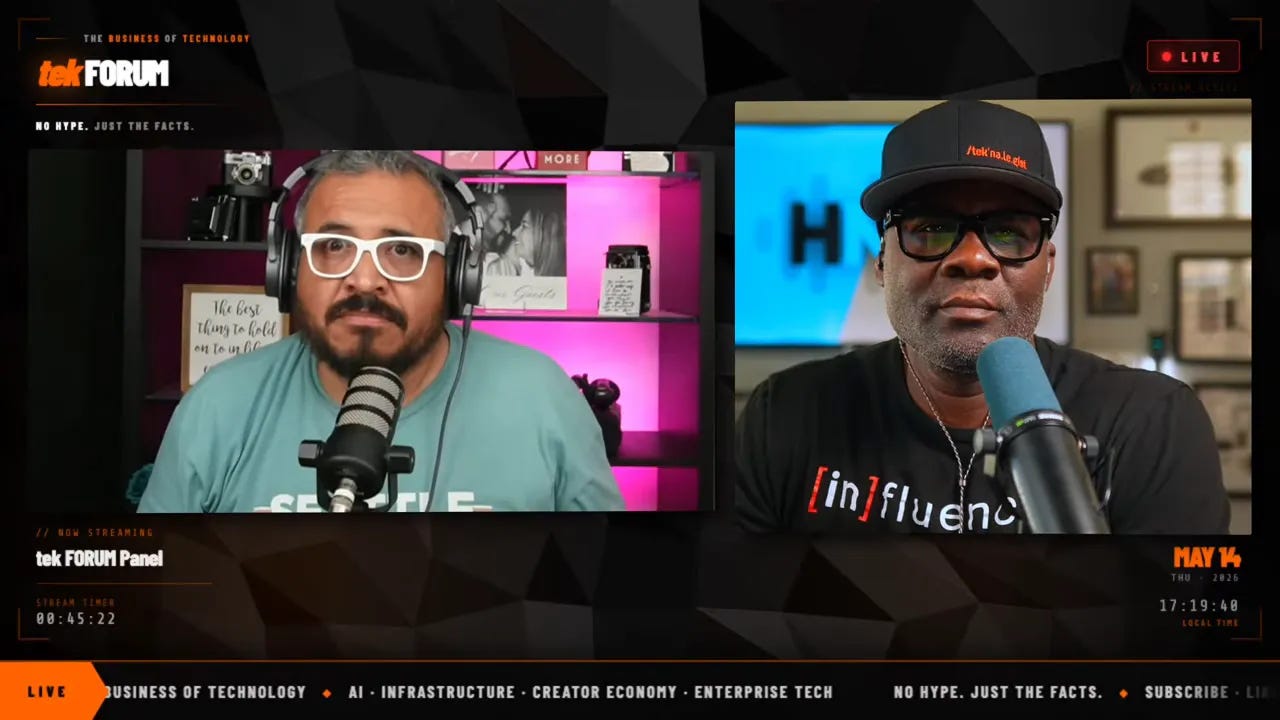
The best way to stay AI-proof has nothing to do with technology
If there is one non-technical skill creators should double down on, it is this:
conversation.
Not just talking. Real conversation.
Listening actively
Responding thoughtfully
Reading the room
Asking better questions
Navigating disagreement respectfully
Having uncomfortable conversations without collapsing into argument
That skill is incredibly hard to fake well.
It matters in podcasting, interviews, leadership, teaching, sales, collaboration, and community-building. It matters in every medium where trust has to be earned.
If that skill did not matter, we would not have public speaking organizations, debate training, keynote circuits, and interview coaching. We would just let machines read slides forever.
People still want the exchange. They still want the energy. They still want the presence.
That is part of the human moat AI cannot easily cross.
Use AI for support, not surrender
A great way to think about all of this is simple:
Use AI for support. Do not surrender your brain cells.
That means:
Let it help with ideation
Let it help with speed
Let it help with structure
Let it remove repetitive labor
Let it reduce technical barriers
But do not let it become your entire point of view.
If AI writes the course, defines the message, shapes the offer, determines your value, and creates the voice, then what exactly are you bringing to the work?
You still need judgment. You still need principles. You still need taste. You still need the ability to say, “No, that is not me.”
What tool is actually indispensable right now?
When the conversation shifted into quick answers, one tool got a direct nod: Claude, especially for creative and operational support around projects, planning, and output development.
That is not a universal answer. Different people will lean toward different models depending on use case, preferences, or principles. Some are experimenting with Claude, Gemini, ChatGPT, or coding-focused tools in evolving workflows.
The bigger point is less about brand loyalty and more about fit. The right tool is the one that helps you work better without hollowing out the quality of what you make.
Is AI reducing or increasing workload?
For creators who have actually built working systems around it, AI is reducing workload dramatically.
One example shared was the ability to record 30 podcast episodes in about three weeks because the surrounding infrastructure had been tightened up so much. The planning, backend support, and content process became easier to manage.
That is a meaningful shift.
It does not mean the work disappears. It means more of your time can go into the parts that require your mind, your voice, and your presence.
The next dominant platform for creators might not look like social media
When asked which platform creators should be paying more attention to, one answer came quickly: Substack.
The reason was straightforward. It combines multiple media formats in one ecosystem:
Written publishing
Audio
Podcast distribution
Community features
Video and live options
Built-in sharing paths to other platforms
For creators trying to consolidate their presence instead of constantly chasing algorithm changes, that kind of all-in-one environment is appealing.
If your work spans writing, speaking, teaching, or audience-building, platforms like Substack deserve serious attention.
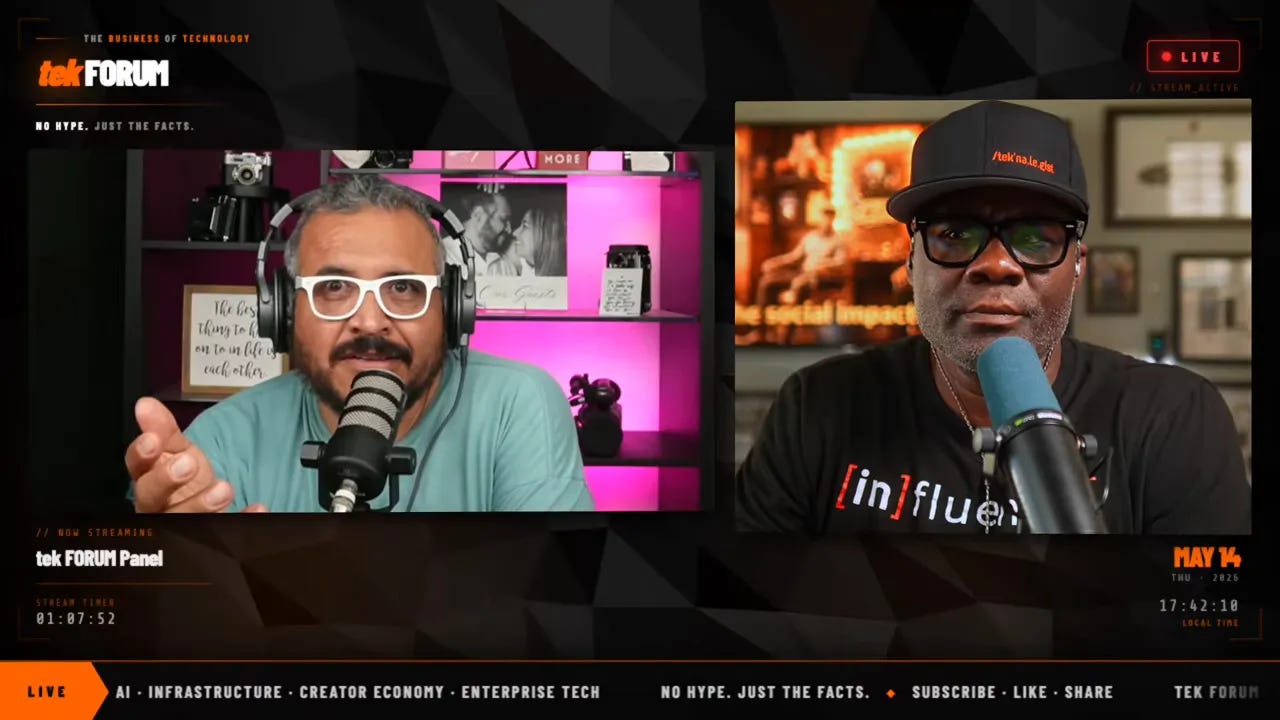
So, is this a creator revolution or a creator replacement?
Right now, it is both a warning and an opportunity.
It is a revolution for creators who understand how to use AI to reclaim time, improve systems, and amplify their actual voice.
It becomes replacement when people hand over all the thinking, all the craft, and all the responsibility to the machine and start producing empty output at scale.
The difference is not the tool. The difference is the operator.
If you know who you are, what you stand for, what value you bring, and what standards your work has to meet, AI can be an incredible force multiplier.
If you do not, it can absolutely flatten your work into generic noise.
The creator playbook from here
If you are trying to make sense of AI without getting lost in hype or fear, this is a strong place to start:
Build systems, not just outputs. Think beyond one-off content creation.
Automate repetitive work. Protect your time and energy for high-value tasks.
Keep your judgment in the loop. Use AI to assist, not replace your thinking.
Protect your human moat. Conversation, storytelling, taste, trust, and lived experience matter more now.
Prioritize value over volume. Abundance makes substance more important, not less.
Stay accountable. Have people around you who will challenge you, not just applaud you.
And maybe most importantly, do not go into any of this uninformed.
Find your people. Learn from practitioners. Test what works. Keep what aligns. Discard what does not.
No one should blindly jump into AI. But no one should ignore it either.
That middle space, where discernment lives, is where the best creator work is going to come from.
Helpful resources for exploring this space
The tools will keep evolving. The pressure will keep increasing. The noise will definitely keep getting louder.
But the creators who stay grounded in value, clarity, and real human connection are still going to be the ones worth listening to.